
- This event has passed.
Conference in Brussels: Towards a Fair Green Transition – Harnessing Research & Innovation for Social Impact
June 17, 2025 11:00 – 17:00
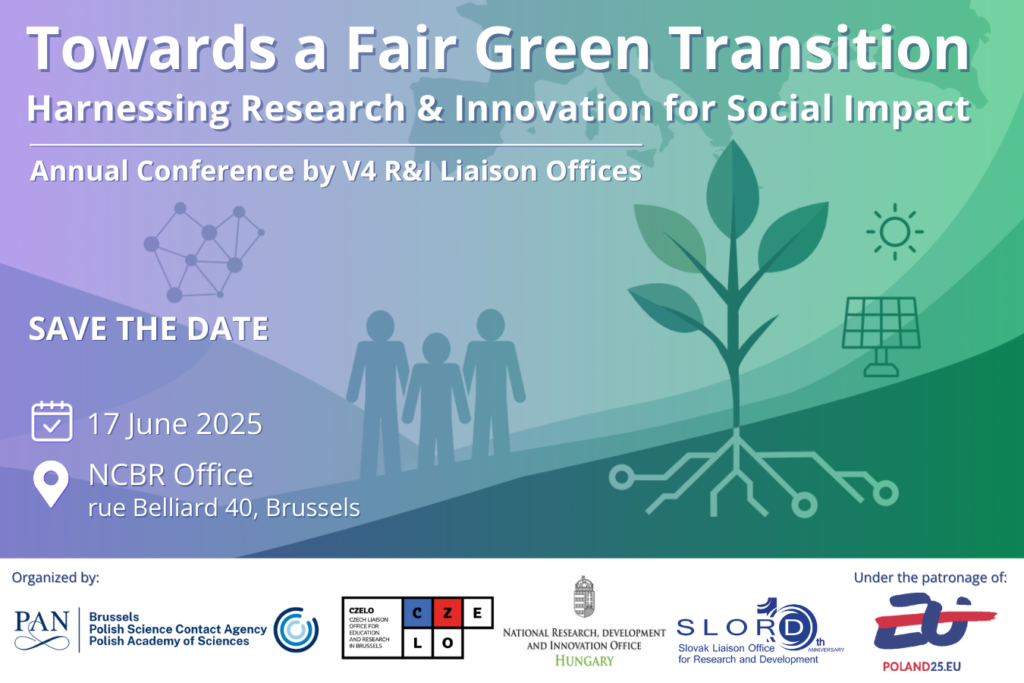
As Europe advances toward climate neutrality, the green transition must be more than technological—it must be fair, inclusive, and socially resilient. This conference explores how research and innovation (R&I), especially from the social sciences and humanities, can drive societal transformation and shape policies that reduce inequalities and support long-term resilience. Through expert panels, scientific dialogue, and participatory exchange, the event will spotlight how R&I can help align environmental goals with social justice. It will take place on 17 June 2025, from 11:00 to 17:00, at the NCBR Office in Brussels, Belgium
Conference rationale
The green and fair transition, as defined by the European Union, marks a transformative shift toward a climate-neutral economy that is socially just and inclusive. This approach ensures that no person or region is left behind, as outlined in the European Green Deal and the European Pillar of Social Rights.
It seeks to combine environmental sustainability with social equity by supporting vulnerable groups, promoting quality employment, and fostering inclusive growth.
At the same time, societies across Europe and beyond are experiencing profound social transformations, driven by a complex interplay of global and regional forces such as climate change, digitalization, demographic shifts, and economic uncertainty. These shifts highlight the urgent need to build resilient societies—those capable of adapting to change and withstanding crises, while maintaining social cohesion, inclusivity, and fairness.
In such a context, research and innovation (R&I) must rise to the occasion. Extraordinary times call for extraordinary efforts, not only in terms of frontier research and breakthrough technologies but also in generating deep societal insights and policy-relevant knowledge. R&I has a pivotal role to play in guiding social transformations, enhancing resilience, and ensuring that the green transition delivers on its promise of a fairer, more inclusive future for all.
The conference objectives
Organised in synergy with the candidate European Partnership for Social Transformations and Resilience (STR) under Horizon Europe, the conference will highlight how R&I can:
- Support fair and inclusive green transition policies
- Enhance Europe’s societal resilience and competitiveness
- Promote social cohesion, reduce inequalities, and foster sustainable growth
Through expert panels, scientific debates, and participatory dialogues, this event will contribute to shaping strategies that ensure the green transition delivers tangible benefits for all Europeans.
Registration open now HERE. Stay tuned for more details!
The conference sessions
11:10 – 12:00 Session I: Framing the Green Future – just transitions start with SSH
This opening panel will explore the critical importance of embedding Social Sciences and Humanities (SSH) in research and innovation (R&I) to effectively tackle Europe’s grand societal challenges. Using the green transition as a lens, the discussion will highlight how SSH insights into social justice, behavioural change, and inclusive governance are essential for shaping climate policies that are not only effective but also fair and equitable.
Speakers from EU science policy community will reflect on how current R&I frameworks can better integrate social dimensions, improve societal resilience, and ensure that transitions do not exacerbate inequalities.
By setting the intellectual tone for the day, this panel will underscore the value of SSH in designing just, inclusive, and impactful green transition pathways—laying the foundation for cross-sectoral dialogue throughout the conference.
12:00 – 13:00 Session II: Understanding the Complexity of the Green Transition – empowering the change
The second session of the conference will place research and innovation at the forefront of addressing today’s evolving societal landscape. As Europe navigates the path toward climate neutrality, it becomes clear that the transition requires more than technological advances in renewable energy or digital infrastructure—it demands a fair and inclusive approach that mitigates inequalities, enhances resilience, and fosters social cohesion.
Featuring leading researchers from across Europe, this session will explore the multifaceted nature of the green transition, examining how it intersects with deep structural social changes. Key issues such as social equity and inclusion of vulnerable groups, social aspects of the green transition for different generations and socioeconomic groups, education for the inclusive green and digital transformation, and citizen engagement will be unpacked, offering critical perspectives on both the challenges and opportunities of this transformation. The session will highlight pathways to ensure that the green transition delivers not only environmental sustainability, but also social justice, democratic stability, and long-term societal resilience.
14:15 – 15:30 Session III: Aligning Strategies – Translating EU Policies into National Actions through HE Partnerships
The third session will explore how national and regional policies can be effectively aligned with European strategies to support a fair, inclusive, and sustainable green transition. By showcasing successful policy-shaping experiences, the session will highlight the critical components of not only designing but also implementing effective policy frameworks. A particular emphasis will be placed on the role of European Partnerships—strategic Horizon Europe initiatives that bring together the European Commission, national governments, public institutions, NGOs, and the private sector to address major challenges such as climate change, biodiversity loss, and digital transformation. The session will also provide a forward-looking perspective on the candidate European Partnership for Social Transformations and Resilience (STR) under Horizon Europe—a strategic initiative that aims to mobilise SSH-driven research to enhance Europe’s societal preparedness and cohesion.
The panel will serve as a forum for sharing best practices and lessons learned on how to effectively translate EU-level objectives into national and regional action plans. It will examine how European Partnerships can act as strategic tools and incentives to align national priorities with EU agendas through joint programming and coordinated investment. By identifying successful models and common challenges, the session aims to support more coherent, inclusive, and impactful engagement of the region in ERA policies.
16:00 – 17:15 Session IV: Bridging Science, Policy, and Practice for a Fair Green Transition – participatory exercise
Session hosted by Joint Research Centre
The final session will take the form of a participatory dialogue, moderated by experts from the European Commission’s Joint Research Centre (JRC)— a team well-versed in connecting the worlds of research and policymaking. This closing session is designed to facilitate active exchange between participants, drawing on their insights and experiences to explore actionable pathways toward societal transformation & resilience in the process of a just green transition.
The session will begin with a JRC-led presentation on key elements of science for policy, highlighting how evidence-based research can more effectively inform and shape social and economic policy frameworks at all levels. Building on this foundation, moderators will open the floor to participants, encouraging discussion on practical experiences related to green transition policies, and efforts to align regional and national strategies with broader European priorities. The session aims to conclude the conference on a collaborative note, capturing reflections and ideas that can help guide future initiatives at the intersection of research, innovation, and policy.
For accessing full agenda click HERE
The organizers
The event is jointly organized by V4 R&I liaison offices based in Brussels: Czech Liaison Office for Education and Research (CZELO), Slovak Liaison Office for Research and Development (SLORD), National Research, Development and Innovation Office of Hungary (NRDIO), Polish Science Contact Agency of the Polish Academy of Sciences (PolSCA) and in partnership with National Science Centre (NCN) of Poland, the coordinator of the Social Transformations and Resilience Partnership.
The audience
This event is designed for a broad spectrum of participants, including:
- Researchers and academics working on climate, societal change, and governance
- Policy professionals from EU institutions and national administrations
- Representatives of Horizon Europe partnerships
- NGOs, think tanks, and civil society actors
- Other stakeholders interested in ERA alignment and inclusive policy implementation
Summary of the event icluding presentations and further reading materials are available HERE


