19th edition of the V4 Training for Research Project Managers
November 23 – November 25
The 19th edition of the V4 Training for Research Project Managers will take place in Brussels on 23–25 November 2026. The three-day training is addressed to professionals involved in research project management and administration. V4 Training is a joint initiative of the Brussels-based liaison offices of the Visegrad countries: CZELO, NRDIO, PolSCA and SLORD.
The programme combines topics related to European research and innovation policy with practical aspects of research project management and administration. To date, more than 580 participants have taken part in the training. While the initiative originated within the V4 cooperation framework, its alumni community now includes research managers and administrators from across Europe.
The 18th edition, held in March 2026, brought together 37 participants representing 10 European countries. A summary of the spring edition is available HERE.
Further information on the programme and application process for the 19th edition will be published soon.
Horizon Europe 2027: Matchmaking Event for AI, Data and Digital Infrastructure
November 12 All day
We invite research organisations, companies and technology users preparing for Horizon Europe 2027 calls in AI, data and digital infrastructure under Cluster 4. The event will take place in Brussels on 12 November 2026. Its main purpose is to connect organisations looking for partners and support the formation of future project consortia.
(wiecej…)Exploring the Role of AI in Research – Annual Conference of the V4 R&I Liaison Offices in Brussels
October 20 All day
Artificial intelligence is becoming an increasingly visible part of research, from developing project ideas and preparing proposals to the way research organisations manage and support their work. This year’s annual conference of the V4 R&I Liaison Offices in Brussels will look at where AI is already changing research practice, what questions these changes raise, and how they are being experienced. On 20 October 2026, the Brussels-based research and innovation liaison offices of the V4 countries will hold the next edition of their annual conference. This year’s event, entitled “Exploring the Role of AI in Research”, will bring together perspectives from the Visegrad region and place them within the broader European discussion on the use of artificial intelligence in research.
AI is already influencing how researchers develop, refine and present project ideas, while research organisations are increasingly exploring its use in administrative and support processes. At the same time, new questions are emerging around responsible use, the skills needed to work effectively with AI, its possible role in proposal evaluation, and the growing pressure on researchers and support structures as application volumes continue to rise.
The conference will address, among other issues, how AI may shape proposal preparation and evaluation, where the boundaries lie between legitimate support and undue influence, and what kinds of institutional support are needed as researchers adapt to changes in efficiency, integrity and day-to-day work. The aim is not to provide ready-made answers, but to compare practical experiences from the V4 countries and contribute them to the wider European debate on the role of AI in research.
The event is jointly organised by the Czech Liaison Office for Education and Research (CZELO), the National Research, Development and Innovation Office of Hungary (NRDIO), the Polish Science Contact Agency of the Polish Academy of Sciences (PolSCA), and the Slovak Liaison Office for Research and Development (SLORD).
The V4 liaison offices organise this conference every year, each time focusing on a topic of current relevance to European research and innovation policy. Last year’s edition explored how research and innovation can contribute to a fair green transition. You can read the summary of the 2025 V4 conference here.
The detailed programme and registration link will be published in early September.
From Soil to Systems: Living Labs and Artificial Intelligence for a Sustainable Future of Agriculture
October 13 All day
Soil is rarely at the centre of conversations about the future of agriculture. We tend to focus on food production, resilience, new technologies, competitiveness and security. Yet all of these questions begin with the same basic resource: healthy soil. Its condition shapes biodiversity, water retention, crop quality and the long-term viability of farming systems.
On 13 October 2026, PolSCA PAS Office, the Committee of Agronomic Sciences of PAS and University of Florence will host a conference in Brussels on soil and plant health, and their role in the future of European agriculture.
Bridging the Gap: Policy, Research and Living Labs
The event will take the EU Mission “A Soil Deal for Europe” as its starting point. As one of the five Horizon Europe Missions, it has helped bring soil health into a broader policy and research debate. Just as importantly, it has moved that debate closer to practice: to farms, regions, field trials and collaborative projects involving farmers, researchers, businesses, public authorities and civil society organisations.
A central theme of the conference will be Living Labs. Rather than treating them as another Brussels policy term, the event will look at what they mean in practice: testing ideas in the places where they are expected to work. In fields, on farms and within local innovation ecosystems, it becomes much easier to see which solutions can make a real difference, and which remain convincing mainly on paper.
Technology and Data in Sustainable Agriculture
The conference will also look at artificial intelligence and the growing role of data in agriculture. Digital tools can help monitor soils, crops and agroecosystems, support precision farming and improve decision-making. At the same time, they raise practical and political questions: who controls agricultural data, who benefits from it, how can digital tools respond to the needs of users, and how can technology support sustainability rather than simply add another layer of complexity?
The event will bring together researchers, practitioners, policymakers, businesses and civil society organisations. It will also refer to ongoing work under European partnerships.
The conference follows on from “Advancing Food Systems in Europe”, organised by PolSCA Office in March 2025.
Draft agenda
09:30-10:00 | Registration and welcome coffee
10:00-10:15| Opening of the conference
10:15-10:30 | Keynote address
10:30–12:15 | Session I
From the Mission Soil to Lasting Innovation Ecosystems: The Future of Living Labs in European Agriculture
This opening plenary session will explore the evolution of the EU Soil Mission from a research and innovation initiative into a catalyst for long-term systemic transformation in agriculture. The discussion will examine how Living Labs have emerged as key instruments for co-creating, testing and scaling sustainable agricultural solutions, while fostering collaboration among farmers, researchers, businesses and public authorities. Looking beyond Horizon Europe, the session will address how Living Labs can be embedded within agricultural innovation ecosystems and what role they may play in shaping priorities and implementation mechanisms under FP10. Particular attention will be given to governance models, sustainability of funding, and pathways for maintaining impact beyond the lifetime of Mission-funded projects.
The session will contain keynote opening, strategic introduction to the agroecology living labs ecosystem, panel discussion and showcase session.
13:30 – 15:00 | Session II
Smart Agroecosystems: Harnessing AI Tools and Crop Diversification for Soil Health
This session explores the synergy between digital innovation and agroecological practices, focusing on the combined potential of AI tools and crop diversification strategies, such as inter-cropping and the integration of legumes, to evaluate and enhance soil health. The discussion addresses key policy directives, environmental impacts, and practical on-farm challenges associated with digital agriculture. By examining both the opportunities and risks of intelligent agroecosystem monitoring, this session aims to bridge policy, scientific innovation, and practical implementation. Attendees will gain insights into the European Strategy for AI in Science, followed by an extended, interactive panel discussion featuring agricultural practitioners.
The session will consist of keynote strategic opening, panel discussion and showcase session.
15.00 – 15.15 | Closing session
15:15 – 17:00 | Networking
Full agenda here: Agenda
Satellite Brokerage Event: Partnering for Nature, Agriculture and Resilience
On 12 October 2026, the day before the conference, the NCBR Office in Brussels will host the international brokerage event “Partnering for Nature, Agriculture and Resilience”.
The event is aimed at researchers, project managers and organisations interested in building consortia for selected 2027 calls under Horizon Europe Cluster 6. The programme will include project idea pitches, a consortium-building workshop and networking opportunities.
Participants are welcome to attend both events. Separate registration is required.
Open registration
Registration is now open. You can register to the conference via registration form: From Soil to Systems – Registration form. The registration form remains open until 6 October 2026.
From projects to scientific ecosystems. Brussels workshop advances the debate on a European Excellence Initiative for FP10
How can Europe give excellent research teams the time, scale and freedom needed to pursue ambitious scientific agendas across borders? This question was at the centre of the European Excellence Initiative workshop, jointly organised by the Permanent Representation of France to the European Union and the Permanent Representation of the Republic of Poland to the European Union, in collaboration with the Polish Science Contact Agency (PolSCA) of the Polish Academy of Sciences.
(wiecej…)AI in research is moving beyond experimentation. Registration is open for the V4 conference “Exploring the Role of AI in Research”
Artificial intelligence is becoming an increasingly visible part of the everyday work of researchers, evaluators and research support professionals. It helps structure ideas, analyse information, draft texts and work with large volumes of data. At the same time, it raises questions that the research community is still learning how to answer. These questions will be at the heart of “Exploring the Role of AI in Research”, taking place in Brussels on 20 October 2026. Registration is open.
(wiecej…)Recruitment opens for “Horizon Europe 2027: Matchmaking Event for AI, Data and Digital Infrastructure”
PolSCA has opened recruitment for participants from Poland for the international “Horizon Europe 2027: Matchmaking Event for AI, Data and Digital Infrastructure”, which will take place in Brussels on 12 November 2026. Ten places are available within the Polish allocation. The event is aimed at organisations preparing for the 2027 Horizon Europe calls in the field of AI, data and digital infrastructure under Cluster 4.
(wiecej…)European Excellence Initiative: how can FP10 support scientific excellence at scale?
September 22 All day
Europe has strong instruments supporting both outstanding individual researchers and collaborative projects. What is still less developed is the space in between: long-term, cross-border research communities built around a shared scientific agenda and able to grow beyond the lifetime and scale of individual projects. This will be at the centre of the workshop “European Excellence Initiative: How FP10 can support long-term large-scale bottom-up and researcher-driven R&I collaborations to boost the EU leadership in science?”, taking place in Brussels on 22 September 2026.
The discussion starts from what could be described as a “missing middle” in the European research funding landscape. Existing EU instruments successfully support individual excellence, collaborative projects and partnerships, but there is still room for long-term, bottom-up and researcher-driven initiatives connecting leading research centres across borders around a common scientific agenda.
One proposal to be explored during the workshop is a European Excellence Initiative within FP10. Such an instrument could support transnational research networks with sufficient scale, scientific autonomy and a long-term funding perspective. The discussion will look at its possible scope, beneficiaries, place within the future Framework Programme and complementarity with existing EU instruments.
The programme will bring together researchers and policy voices to discuss how FP10 could help Europe scale up scientific excellence. The round table will include René Repasi, Member of the European Parliament and Rapporteur on the FP10 specific programme, Krzysztof Pyrć, President of the Foundation for Polish Science, Nils Wörner from the German Rectors’ Conference and Fabrice Lemoine from the University of Lorraine. Aleksandra Pękowska from the Dioscuri Centre at the Nencki Institute of Experimental Biology of the Polish Academy of Sciences will also share a researcher’s perspective.
The event is co-organised by the Permanent Representation of France to the European Union and the Permanent Representation of the Republic of Poland to the European Union, in collaboration with the Polish Science Contact Agency PolSCA of the Polish Academy of Sciences in Brussels.
Agenda of the event HERE.
V4 Training for Research Project Managers – applications now open for the 19th edition!
The 19th edition of the V4 Training for Research Project Managers will take place in Brussels on 23-25 November 2026. The training is jointly organised by the four Visegrad Group liaison offices for research and innovation: the Czech Liaison Office for Education and Research (CZELO), National Research, Development and Innovation Office (NRDIO), Polish Contact Science Agency (PolSCA) of the Polish Academy of Sciences, and Slovak Liaison Office for Research and Development (SLORD). PolSCA is now inviting applications for 9 places available to participants representing Polish institutions.
(wiecej…)Wrap-up: PolSCA Masterclass – Research Project Management with PM2 Methodology
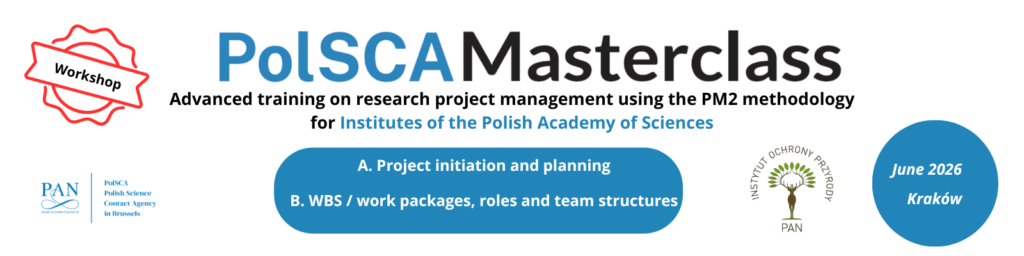
June 2026 brought two editions of one of the most hands-on workshops in PolSCA PAN’s training offer. The in-depth workshop on research project management using the PM2 methodology took place on 18-19 and 24-25 June at the Institute of Nature Conservation PAN in Kraków. Across four days – spread over two groups – 45 researchers and research managers from PAN institutes and units got to work on what is often the hardest part of research work: turning a good idea into a well-managed project.
(wiecej…)Next Page »


