
- This event has passed.
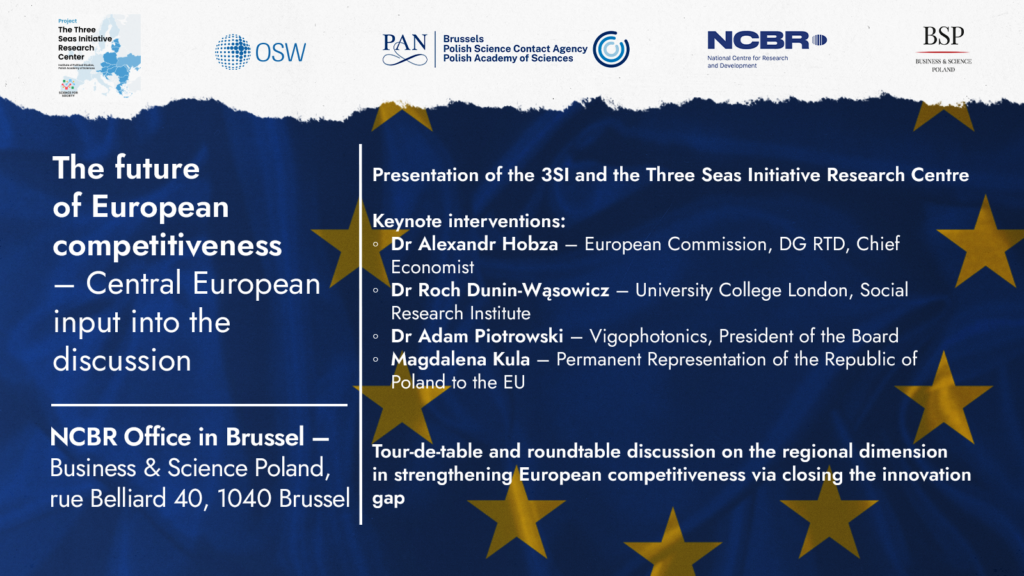
The future of European competitiveness – Central European input into the discussion
October 16, 2024 10:00 – 12:30
A round-table discussion organized by the Three Seas Initiative (3SI) Research Center at the Institute of Political Studies of the Polish Academy of Sciences (ISP PAN) and the Center for Eastern Studies (OSW) and hosted jointly by the Polish Science Contact Agency PolSCA of the Polish Academy of Sciences and the National Research and Development Centre (NCBR) in Brussels
16 October (Wednesday), 2024 at 10:00 – 12:30
Venue: NCBR Office in Brussels – Business & Science Poland, Rue Belliard 40, 1040 Brussels
The recently published report by Mario Draghi greatly contributes to the ongoing debate how the EU should act to maintain its competitiveness towards the US and China. The recommendations relate to both sectoral (energy, pharma, AI, transport) and horizontal (innovation, skills, governance) policies. Report stresses clearly the EU’s weakness in closing the innovation gap. As stated, the EU innovation potential remains underused, as researchers and innovators do not fully exploit economies of scale of the Single Market and cooperate with other partners across the EU.
However, one crucial potential of the EU innovativeness hasn’t been marked enough in the report. That is the exploitation of the innovativeness potential of Central Europe, which could greatly contribute to strengthening European competitiveness. The countries of the region, which face the same socio- and economical challenges, are ahead of a difficult task to upgrade its economic model from cost-based to much more innovation-driven. Therefore, as the funds for cohesion will be gradually decreased for the states of Central Europe, they need to take an active part in the debate on research cooperation within the EU to invest and attract much more funding as well as creating preferable conditions for prioritizing research and transfer of knowledge to further fuel the economic growth. The Three Seas Initiative (3SI), which was launched in 2016 and links thirteen EU states, is a good platform to discuss these challenges and to consider how to structure the cooperation to make the most efficient.
Thus the aim of the round- table discussion is discuss the Central European perspective on the The future of European competitiveness report, the regional dimension of the scientific cooperation as well as the next programme for research and innovation in the new Multiannual Financial Framework. During the seminar we would like to present a report published by the Centre for Eastern Studies (OSW), entitled A glass half full. Searching for new sources of economic growth in Central Europe indicating the most important challenges on the EU level for the innovativeness of the Central Europe. Afterwards we would like to openly discuss, howto elevate the importance of scientific research and expertise by promoting expert-level cooperation and to encourage international collaboration among research and socio-economic entities within the Central Europe and to identify the areas of the cooperation on the EU level.
Detailed agenda available here.
The meeting is by invitation only and will follow Chatham House Rule principles.


