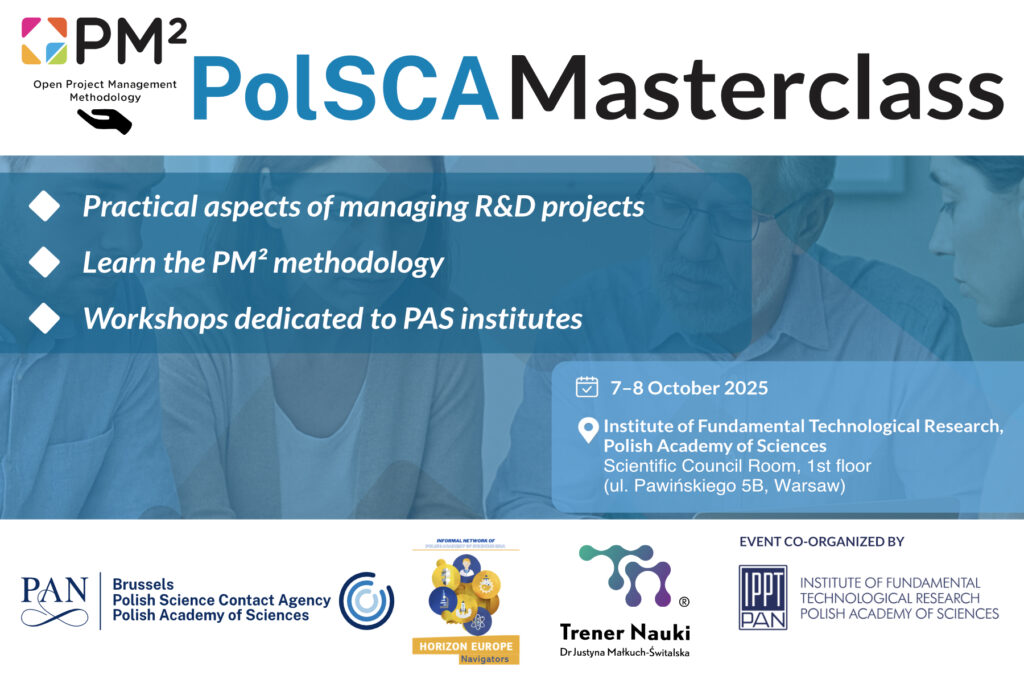
On 7 and 8 October 2025, a two-day workshop on the practical aspects of managing research projects using PM², the European Commission’s project management methodology, was held at the Institute of Fundamental Technological Research of the Polish Academy of Sciences (IPPT PAN). The event was organised by the PolSCA PAS Office in cooperation with IPPT PAN as a part of activities for the Horizon Europe Navigators network of research managers at PAN institutes. The sessions were led by Dr Justyna Małkuch-Świtalska – trainer and expert in project management and research careers, author of Projekty naukowe. Zarządzanie w praktyce (PWN, 2020) – who has delivered over 2,500 hours of training in Poland and abroad and works with Trener Nauki.
Aim and scope
The second edition of the PolSCA Masterclass in 2025 aimed to familiarise participants with tools and techniques that support planning, delivery and monitoring of EU-funded projects, with a particular focus on the project life cycle, roles and team structures, risk and change management, and communicating results in line with the Commission’s requirements (DEC). The programme was built around exercises and case studies that mirror real grant contexts. The workshop continued an earlier online information session on project management run by PolSCA as part of the HE Navigators MeetUp: » Horizon Europe Navigators MeetUp: Project Management with focus on PM2.
Programme and its flow
Over two days, participants progressed from PM² basics to advanced project practice.
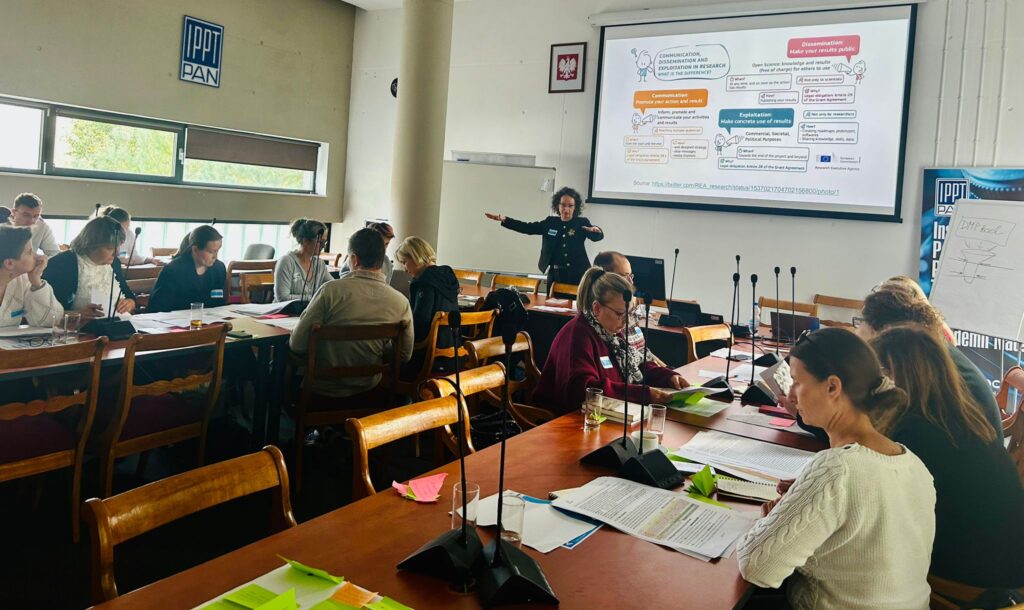
Day 1 started with pointing out the differences between project management, grant administration and research work. We mapped the project life cycle in PM² as a hybrid methodology combining waterfall and agile elements. We discussed roles and team structures, the responsibility matrix (ARSCI/RACI) and the work breakdown structure (WBS), translating objectives into concrete tasks and results in the outputs → outcomes → benefits logic. The trainer highlighted the importance of the PM² “artefact landscape”: a coherent set of documents, checklists and reports guiding teams through initiation, planning, execution and closure. On day 2 we focused on the hard parts: precise definitions of risk, issue and change; choosing response strategies (e.g. avoid / transfer / mitigate / accept and exploit / share / enhance); and hands-on work with the Risk Log and a risk management plan. We aligned communication with DEC requirements, distinguishing communication, dissemination and exploitation, and tied these to continuous reporting in Horizon Europe (deliverables and milestones). The capstone was an intensive case study: updating the stakeholder matrix (influence-interest), refining roles and communication channels, and walking the “risk → issue” path for scenarios involving scope and schedule changes.
Format and methods
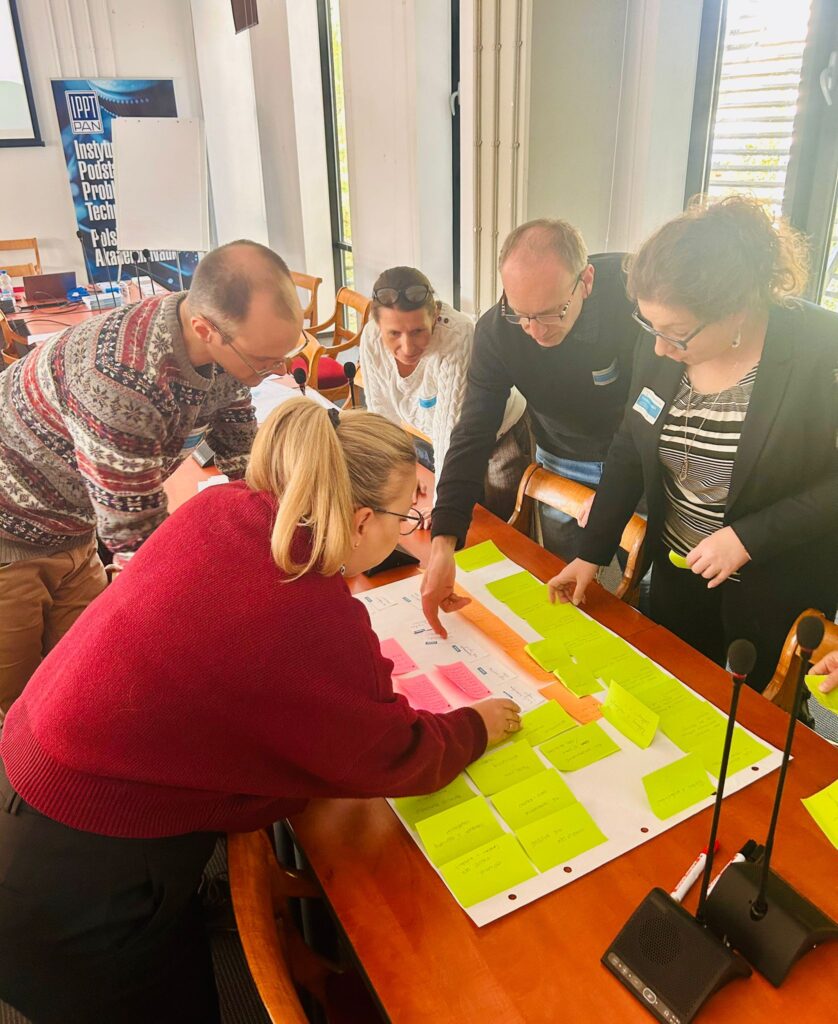
The workshop was highly interactive. In groups, participants built a mini project handbook (SMART objectives, WBS, work packages and responsibilities), mapped stakeholders, assembled core PM² artefacts and drafted a DEC-compliant communication plan. Work was continuously tested against real PM² practice. Key takeaways for practitioners included:
- PM² as a “shared language”. It facilitates interdisciplinary cooperation and bridges scientific, administrative and managerial perspectives.
- Proactive risk management. Early identification, naming an owner and selecting a concrete response strategy reduces the number of fires to put out.
- DEC “from day one”. Communication and pathways for uptake/exploitation should be designed alongside the research plan and budget, aligned with Horizon Europe’s continuous reporting.
- Roles matrix and WBS. Clear responsibilities (RACI/ARSCI) and realistic work packages are the best prevention against delays and “communication bottlenecks”.
Takeaways for institutions
The workshop showed that investing in joint PM² training for operational teams creates
a common working language that supports decision-making, clarifies responsibilities and leads to coherent reporting. Staff training strengthens day-to-day planning, monitoring and communication in projects. It was also noted that engaging and training directors and senior management translates into clear governance frames, realistic expectations and better conditions for rolling out standards organisation-wide. As a result, institutions gain greater predictability and project resilience – from initiation and budgeting through delivery, change response and closure – while a culture of “learning from experience” becomes part of continuous improvement.
Evaluation and what’s next?
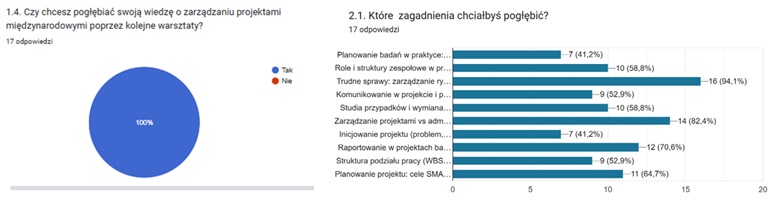
Immediately after the workshop we ran a short participant survey. Responses show strong approval of the format and a clear demand to continue similar trainings on a regular cycle. All respondents declared interest in future workshops. The most frequently indicated priorities for deeper dives were: advanced risk and change management; roles and team structures (including precise responsibility assignment); planning and monitoring DEC-compliant communication; precise budgeting of work packages (with emphasis on KPIs/SMART); and standardising WBS and RACI roles in the realities of PAN institutes. The workshop received high ratings for organisation, delivery and substantive value, and comments repeatedly asked for further, in-depth modules and shorter, thematic practical sessions (e.g. risk/change, DEC, work planning) that would allow direct transfer of good practice into ongoing projects.

The event is part of PolSCA’s efforts for the Horizon Europe Navigators network, launched in 2021 at PAN to strengthen competences and exchange good practices on Horizon Europe among research managers and administrators in PAN institutes. Over 20 participants took part in the two-day training, the vast majority being members of the Navigators network.
We thank all participants for their active engagement, sharp questions and willingness to share experience. As the PolSCA PAS Office team in Brussels, we believe such hands-on work helps translate tools like PM² into real project procedures used daily in PAN institutes’ teams.
After the training, there was a short networking meeting with representatives of the newly established Polish Association of Research Managers and Administrators (PolARMA).
Download full summary document HERE


