IGLO Open on the Priorities of the Estonian Presidency of the Council of the EU 2017
Estonian Liaison Office for EU Research and Development kindly invites you to the next IGLO Open on the Priorities of the Estonian Presidency of the Council of the EU 2017.
The topic is focused on the research and innovation priorities of the Estonian Presidency of the Council of the European Union in the second half of 2017.
The invited speakers are Ms Maia-Liisa Anton and Ms Ursula Tubli, the Scientific Counsellors from the Permanent Representation of Estonia to the EU.
The meeting will take place at KoWi (Rue du Trône 98, 8th Floor, Brussels) and is followed by a networking lunch hosted by the PolSCA Office.
Move to a Circular Economy in Poland – Current State and Perspectives
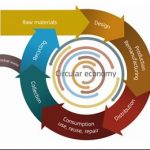
A circular economy means a continuous re-use and recycle of materials. It requires a new design of products so that they last longer, and become more repairable, reusable and recyclable and implementation of new technologies but also a change of societal mindset. Transformation towards a zero-waste economy and society entrains costs but also brings about benefits.
The European Commission is currently working on a legislative package on the circular economy that should become the EU law in the period 2016-2019.
The aim of the conference is to discuss how circular economy is implemented in Poland, what are the main challenges and benefits stemming from this process. This exchange of opinions will be a contribution to the EU deliberations.
Below you will find agenda
PRESENTATIONS
The European Committee of the Regions (CoR) offers MOOC “EU budget and funding for regions and cities”
The European Committee of the Regions (CoR) offers this MOOC to contribute to capacity-building of regional and local authorities with regard to EU affairs, more particularly on EU budget and funding for regions and cities. While regions and cities matter in EU policy-making, they may have a limited knowledge of how the EU budget works and what are the possibilities for accessing EU funds. The course will attempt to fill this knowledge gap.
This MOOC has been co-created with the European Investment Bank (EIB) and the European Commission – Directorate-General for Regional and Urban Policy (DG REGIO) and Directorate-General for Budget (DG BUDG).
The course consists of videos, factsheets, infographics and web-streamed live debates with Q&A from the course participants. Moreover, course followers can interact and contribute via social media and fora. The course will last six weeks, starting on 31 October and ending on 9 December 2016. Studying time is about two hours per week. The course material will remain available online until 31 July 2017.
https://www.fun-mooc.fr/courses/CoR/114001/session01/about
Impact of research projects granted from Horizon 2020

We are presenting a paper on impact of research projects granted from Horizon 2020 (in Polish)
http://nauka-pan.pl/index.php/nauka/article/view/644/659
Interim review of Horizon 2020
http://ec.europa.eu/smart-regulation/roadmaps/docs/2015_rtd_005_evaluation_ie_horizon_2020_en.pdf
http://www.europarl.europa.eu/RegData/etudes/STUD/2016/572678/IPOL_STU(2016)572678_EN.pdf
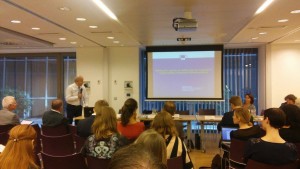
ESFRI and national research infrastructures – current challenges from perspective of V4 countries
|
|
 |
AGENDA
| 9.30 – 10.00 | Registration |
| 10.00 – 10.10 | Welcome address, Sebastian Barkowski – First Counsellor, Permanent Representation of the Republic of Poland to the European Union in Brussels |
| 10.10 – 10.40 | Paving the way for an action plan for Long-term sustainability of Research Infrastructures, Antonio di Giulio – Head of Unit, B.4: Research Infrastructure, Directorate B – Open Innovation and Open Science, European Commission, DG Research & Innovation |
| 10.40 – 11.10 | Research infrastructure life cycle methodology, David Bohmert, Swiss delegate to ESFRI |
| 11.10 – 11.30 | Integrated approach to geophysical hazards induced by exploration and exploitation of georesources – to facilitate the way of attaining excellence, Prof. Stanisław Lasocki – EPOS „European Plate Observing System”, Polish Academy of Sciences |
| 11.30 – 11.50 | SOLARIS – the first large scale research facility in Poland, Prof. Marek Stankiewicz, Director of SOLARIS – the Polish national synchrotron, Jagiellonian University |
| 11.50 – 12.00 | Coffee break |
| 12.00 – 13.00 | Panel discussion – V4 research infrastructures and ESFRI – main challenges
Dominik Sobczak – ESFRI Executive Secretary, European Commission, DG Research & Innovation – moderator
Konrad Dębski – Department of Innovation and Development, Ministry of Science and Higher Education, Poland Dr. Wiesław Studencki – National Contact Point for Research Programmes of the EU in Poland David Bereczkei – ELI –DC, project manager- coordinator, Hungary Roman Hvězda – Deputy Director for Projects of Operational Program R&D&I, ELI project manager, Czech Republic Ondřej Hradil – Senior Analyst, CEITEC, Czech Republic Dr. Pavol Siman – Member of the Presidium, Slovak Academy of Sciences |
| 13.00 – 14.00 | Networking lunch |
PRESENTATIONS
Paving the way for an action plan for Long-term sustainability of Research Infrastructures, Antonio di Giulio
https://drive.google.com/file/d/0B3OugwAmC182SEpzZVVCd2dtSk0/view?usp=sharing
Research infrastructure life cycle methodology, David Bohmert
https://drive.google.com/file/d/0B3OugwAmC182SE1MN2w3MVFJTXM/view?usp=sharing
Integrated approach to geophysical hazards induced by exploration and exploitation of georesources – to facilitate the way of attaining excellence, Prof. Stanisław Lasocki
https://drive.google.com/file/d/0B3OugwAmC182eXlHM0RZRkRweE0/view?usp=sharing
SOLARIS – the first large scale research facility in Poland, Prof. Marek Stankiewicz
https://drive.google.com/file/d/0B3OugwAmC182ejd3aVlMRkU3MDA/view?usp=sharing
Seminar – UAS4EUROPE: Smart Partnerships for Regional Impact
Energy efficiency improvements in the health sector – best practices in European regions
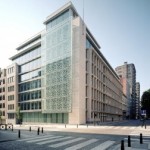
The seminar is organised for the 5th time by the Regional Office of Silesia in Brussels, in cooperation with the States of North Rhine-Westphalia, the Nord-Pas-de-Calais Representation in Brussels and the Polish Science Contact Agency “PolSCA” of the Polish Academy of Sciences.
Healthcare facilities are among the most energy-intensive ones. The EU healthcare sector plays a major role in Europe’s economy. Greater attention has to be given to constructing more energy-efficient buildings across the EU. There should also be more emphasis on renewable heating systems and moves towards cleaner fuels.
The aim of the seminar is to provide an opportunity for local, regional and EU stakeholders to discuss options, best practices and solutions in the field of energy solutions in the medical sector and also in connection with the use of renewable energy.
V4 for researchers’ mobility: supporting young researchers on the way to excellence
V4 conference_V4_mobility_14_06_2016_INVITATION
V4 Meeting of the Presidents of the Academies of Sciences
MARCH 1, 2016
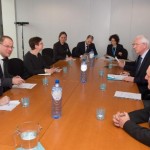
The Presidents of V4 Academies of Sciences met the Commissioners: Carlos Moedas and Tibor Navracsics.
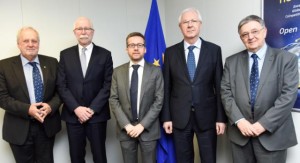
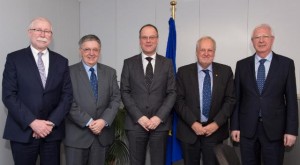
They discussed issues related to Scientific Advice Mechanism (SAM), research infrastructures and synergies with ESIF, ERA, lifelong learning, training of scientists and EIT.
The Presidents exchanged opinions on cooperation with JRC during lunch with Director General of JRC Vladimír Šucha, then they had a meeting with the president of ERC Jean Pierre Bourguignon focused on participation in ERC projects.
In afternoon the Presidents took part in the panel debate at the premises of Czech Permanent Representation.
MARCH 2, 2016
The Presidents visited IMEC.
http://www2.imec.be/be_en/home.html
Next Page »« Previous Page


