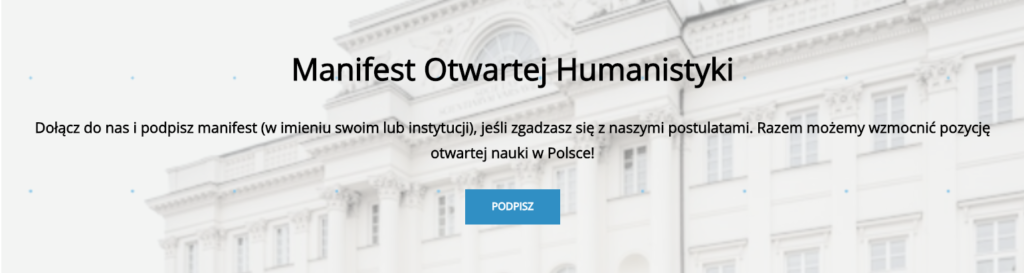
The Digital Humanities Center at the Institute of Literary Research of the Polish Academy of Sciences has published the Open Humanities Manifesto, which addresses the current challenges and needs of the humanities. The goal of the Manifesto is to highlight the issue of evaluation criteria not aligning with the actual research practices in the humanities. The authors aim to inspire the Polish academic community and policymakers to implement the necessary changes in this area.
Read the full Manifesto and see the list of signatories here: Open Humanities Manifesto
You can support the Manifesto by signing it through this form: Open Humanities Manifesto
We also encourage you to read the article about the Manifesto on the Forum Akademickie website: Manifesto of Open Humanities
Key Points of the Manifesto
In the age of digital communication, the humanities are becoming increasingly open, transparent, and accessible. Drawing on international initiatives such as Open Access, Open Data, and Open Peer Review, the Manifesto promotes the development of open scientific research, free from economic and geographical barriers.
The Manifesto is built on four key pillars:
- The evaluation system should support and reflect open science practices.
- The assessment of research contributions should include diverse scholarly outputs unique to the humanities.
- Publishers should be encouraged to adopt and maintain open access publication models.
- The growth and internationalization of the humanities require strengthening the national open science infrastructure.
This initiative is supported by OPERAS-PL, a project led by the Digital Humanities Center at the Institute of Literary Research of the Polish Academy of Sciences, in collaboration with the European research infrastructure OPERAS. The head of the Digital Humanities Center is Dr. Maciej Maryl, a member of the Program Council of the PolSCA Office.
We invite you to explore the full text of the Manifesto and join the signatories.
Together, we can support the advancement of open science and contribute to a better future for the humanities.
We invite you to explore the full text of the Manifesto and join the signatories.
Together, we can support the advancement of open science and contribute to a better future for the humanities.


