How do you find the right partners for an international research project? Where do you start when building a consortium, and how can you attract the interest of organisations abroad? The answers to these questions often emerge not from reading call documents, but from conversations with potential partners. This is precisely what European brokerage and matchmaking events offer researchers looking to take part in Horizon Europe projects.
Researchers from three institutes of the Polish Academy of Sciences (PAS) experienced this first-hand at international events held recently in Paris and Brussels. They represented different research disciplines and arrived with different expectations, but their experiences point to a common conclusion: stepping outside your usual research circles, presenting your expertise and meeting potential collaborators can open up opportunities for future projects.
A Good Project Needs the Right Partners
Even the strongest research proposal depends on having a team capable of delivering it. In Horizon Europe, finding partners with complementary expertise can be just as challenging as preparing the proposal itself.
Brokerage events can help shorten this process. They bring together researchers, businesses, public institutions and other organisations interested in international collaborative projects. Some participants are looking for partners to join consortia already taking shape, while others arrive with a research concept they hope to develop further.
The greatest value often lies in the conversations themselves. A fifteen-minute meeting may be enough to establish whether research interests overlap, identify missing expertise in a consortium or see whether there is a basis for working together. Not every contact will lead to an immediate result, but even a short conversation can open the door to a future project.
And potential partners are not always found within one’s own discipline. Sometimes, talking to researchers or organisations from a completely different field reveals applications for existing research that had not previously been considered.
You Don’t Need a Fully Developed Project to Start a Conversation
One question researchers may ask before attending a matchmaking event is whether their project concept is sufficiently developed and whether they have something concrete to offer potential partners.
Yet these events can be equally valuable at a much earlier stage. They offer an opportunity to test whether a proposed solution addresses the needs of potential end users, identify the expertise required to develop it further and gauge interest from other organisations.
A good example comes from Ewa Zduńczyk of the Hirszfeld Institute of Immunology and Experimental Therapy, PAS, and Denis Cerić of the Institute of Geography and Spatial Organization, PAS. Both attended “The New Era of European Borders and Defence Innovation”, held in Brussels on 23–24 September 2026.
The event explored opportunities for research and project collaboration in border security and defence innovation, including under Horizon Europe and the European Defence Fund. Its programme combined expert presentations, institutional pitches and individual matchmaking meetings.
For Ewa Zduńczyk, one of the main objectives was to present her institute as a potential partner not only in biomedical research, but also in security-related projects. The institute has expertise and existing solutions in the detection and identification of biological threats, which could be applied, among other areas, to the protection of the EU’s external borders.
The event provided an opportunity to introduce this work to potential partners and discuss it with organisations from different sectors. Particularly valuable were the face-to-face conversations with companies, research organisations and representatives of bodies supporting innovation and collaboration.

Ewa Zduńczyk
Hirszfeld Institute of Immunology and Experimental Therapy, Polish Academy of Sciences
“People attend matchmaking events because they want to make connections, so finding partners feels easier and more natural.”
This experience also illustrates how brokerage events can reveal new applications for research that has been pursued for years. Expertise developed primarily for one field may turn out to be highly relevant in another.
Look for Partners Beyond Your Own Research Field
Interdisciplinary collaboration is an important part of Horizon Europe. Developing a new technology is often only one element of a project. Social and economic analysis, regulatory expertise, research into user behaviour and assessments of the impact of proposed solutions may be equally necessary.
This is why researchers should not necessarily limit their search for collaboration opportunities to the calls that most obviously match their institution’s profile.
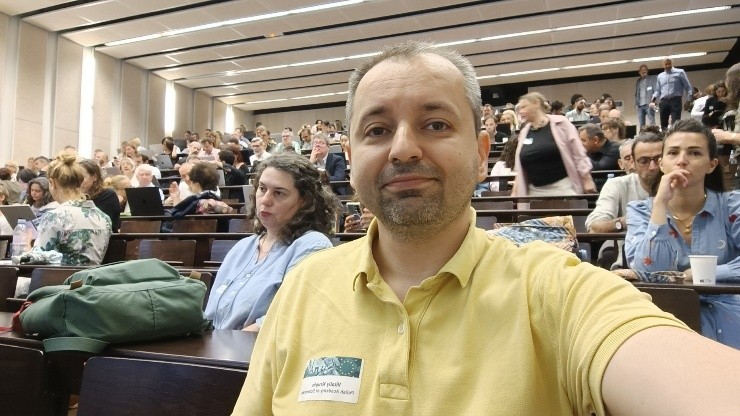
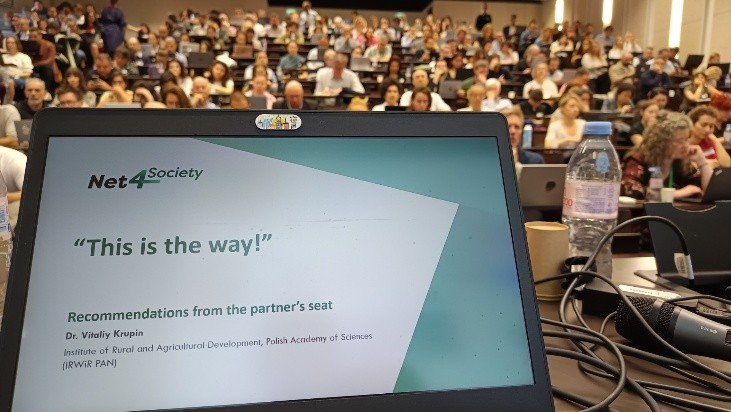
This was one of the messages shared by Dr Vitaliy Krupin from the Institute of Rural and Agricultural Development, PAS, who attended the “Net4Society Matchmaking Event for 2026 Cluster 2 Calls” in Paris on 1–2 June 2026.
Organised by Net4Society, the international network of National Contact Points for Cluster 2, the event brought together researchers and organisations interested in the Culture, Creativity and Inclusive Society calls under Horizon Europe. More than 350 participants from over 40 countries attended.
Dr Krupin was invited to speak at a session dedicated to preparing successful project proposals. Drawing on the experience of his institute in international research consortia, he highlighted the role of social sciences and humanities (SSH) in European collaborative projects.
One of his central messages was that SSH researchers should look beyond Cluster 2 when seeking opportunities in Horizon Europe. Their expertise is also needed in projects addressing climate, energy, agriculture, industry and technology, where understanding social behaviour, governance and economic implications can be essential.
The experience of the Institute of Rural and Agricultural Development also shows how a research organisation can gradually strengthen its position in international consortia. The institute’s journey began in 2017 with a relatively small role in a Horizon 2020 project. Over time, the team gained experience, built trust among its partners and took on greater responsibility for tasks and work packages.
Dr Vitaliy Krupin
Institute of Rural and Agricultural Development, Polish Academy of Sciences
“A small role in a project is not a small opportunity. It is an investment in connections, credibility and experience that makes future projects possible.”
From an Initial Contact to a Concrete Project Concept
Brokerage events can produce tangible results, even if these are not always immediately visible.
During the Paris event, Dr Krupin held both scheduled bilateral meetings and additional discussions with representatives of organisations from across Europe. His new contacts included institutions from Belgium, France, Switzerland, the United Kingdom, Türkiye, Greece and Cyprus.
Two conversations led to preliminary concepts for joint research proposals. The first, with a representative of Edinburgh Napier University, concerned youth employment, including in rural areas. The second, with a representative of the Turkish regional administration, explored systemic approaches to providing care for older people, also including rural communities. In both cases, the expertise of the Institute of Rural and Agricultural Development in rural studies could provide a valuable contribution to a future project.
Moreover, within just two weeks of the event, Dr Krupin received follow-up messages from more than five participants expressing an interest in further collaboration.
Of course, these conversations do not yet amount to established consortia or secured funding. They do, however, demonstrate how a well-used brokerage event can lead to further discussions, the exchange of research ideas and the development of joint proposals.
How to Make the Most of a Matchmaking Event
Simply attending an event does not guarantee valuable new contacts. Preparation makes a considerable difference.
It is worth reviewing the list of participating organisations in advance, exploring their profiles and identifying those whose research interests or expertise could complement your own. Scheduling one-to-one meetings before the event is generally more effective than relying entirely on chance encounters during coffee breaks.
Equally important is being able to present your institution’s expertise clearly and concisely. Potential partners need to understand not only what your research team does, but also what it could contribute to a joint project.
A short presentation, examples of previous research achievements, a clear description of your areas of interest and concise information materials can all help.
Dr Denis Cerić
Institute of Geography and Spatial Organization, Polish Academy of Sciences
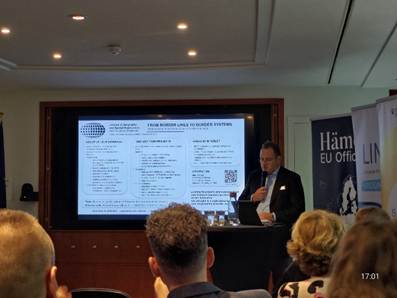
Dr Denis Cerić, from the Institute of Geography and Spatial Organization, PAS, shared his experience of attending the Brussels event “The New Era of European Borders and Defence Innovation”.
For him, participating in an event focused on border security was not an obvious choice at first. The subject might have seemed somewhat removed from traditional geographical research. Yet geography provides valuable insights into the spatial, social and economic dimensions of borders, as well as the impact of new security solutions on border regions.
In his presentation, “From Border Lines to Border Systems”, he introduced the institute’s expertise in land and maritime border studies, cross-border cooperation, mobility, and spatial and territorial analysis.
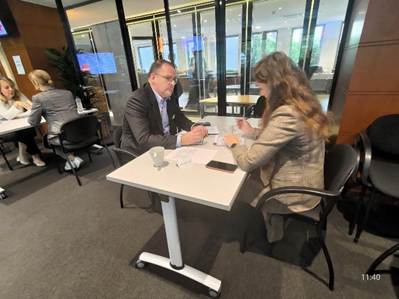
He also held three scheduled bilateral meetings with representatives of Empedus, Luna Robotics and Oost NL, while additional contacts emerged through informal conversations. A leaflet prepared in advance, outlining the institute’s expertise and potential contribution to future consortia, proved useful in presenting its research capabilities.
It is also worth remembering that the conversation does not end when the event does. Following up with new contacts, sharing additional information, clarifying common research interests or arranging another online meeting can make the difference between a brief introduction and a lasting collaboration.
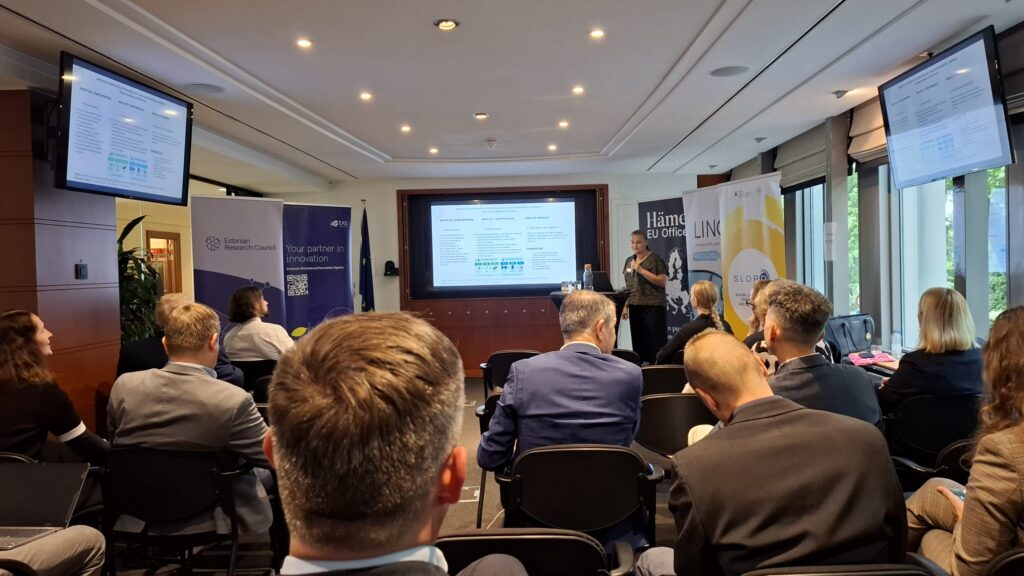
As Ewa Zduńczyk points out, the full value of participating in a matchmaking event can only be assessed over time. For now, her priority is to follow up with potential partners and continue the conversations started in Brussels.
The Benefits That May Take Time to Emerge
Not every brokerage event results in an invitation to join a consortium. Not every promising conversation turns into a joint proposal. But that does not mean attending was a waste of time.
An event may help researchers better understand the European research landscape, discover emerging priorities in their field, learn about upcoming funding opportunities or test a project concept against the experience of other organisations.
There is also the question of visibility. By actively participating in international events, researchers and their institutions become more familiar to potential partners and project coordinators.
During his presentation in Paris, Dr Krupin placed particular emphasis on trust. The experience of his institute suggests that invitations to join new consortia often grow out of previous successful collaborations. Partners who deliver their work on time, contribute meaningful expertise and actively engage in proposal development are more likely to be invited to work together again.
Networking is therefore worth approaching not as a one-off attempt to find a project, but as part of the longer process of building professional relationships and research partnerships.
How PolSCA Supports Researchers in Building European Partnerships
Supporting Polish researchers in their participation in international brokerage and matchmaking events is part of the work of the Polish Science Contact Agency (PolSCA) in Brussels.
For the event on border security and defence innovation, participants from PAS institutes received organisational support from the PAS Office for International Cooperation and PolSCA. Preparations also included an online consultation on institutional presentations, networking and matchmaking meetings.
Dr Krupin’s participation in the Net4Society event in Paris was supported and coordinated by PolSCA, with assistance from the PAS Scientific Centre in Paris and in cooperation with the National Centre for Research and Development (NCBR).
Funding opportunities can also make participation more accessible. One example is the NCP_WIDERA.NET Travel Grants scheme, which provides eligible applicants with financial support for travel and accommodation costs when attending qualifying brokerage events.
Combined with practical organisational assistance, such support can help researchers connect with international partners, explore opportunities for collaborative research and become more actively involved in European projects.
Taking the First Step
Researchers do not need a complete project proposal or an extensive network of international contacts to benefit from a European matchmaking event. What matters is knowing their own strengths, having an idea of where they would like to develop collaboration and being open to conversations.
The experiences of researchers from PAS institutes show that these events can generate new project concepts and valuable contacts, while also offering fresh perspectives on how existing research might be applied.
Sometimes, the most important outcome is simply meeting someone who, a few months later, gets in touch with an invitation to prepare a proposal together.
It is therefore worth keeping an eye on upcoming brokerage and matchmaking events, including those that may initially seem outside your institute’s usual areas of research. Your next European project partner might be closer than you think.


