EIC Pathfinder Masterclass for PAS Institutes – Event Summary
The EIC Pathfinder Masterclass brought together 50 representatives from the worlds of science and innovation to jointly explore the intricacies of successfully applying to the prestigious EIC Pathfinder program. The event served as an inspiring platform for exchanging knowledge, experiences, and strategies that can bring Polish Academy of Sciences’ research institutes closer to becoming European leaders in breakthrough innovations.
On March 20, 2025, the EIC Pathfinder Masterclass workshop was held at the Institute of Physics of the Polish Academy of Sciences (PAS) in Warsaw. It was organized by the PolSCA PAS Office in Brussels, in cooperation with representatives of the European Innovation Council (EIC), the National Contact Point, and experts from Polish research institutions. Co-organizers included the Institute of Physics PAS and the Centre for Theoretical Physics PAS. The event aimed to enhance the application effectiveness of Polish research institutes, particularly PAS institutes, in EIC Pathfinder program calls. It gathered 50 scientists, experts, grantees, and representatives from administration and innovation support institutions.
(wiecej…)The European Innovation Council (EIC) has announced the selection of 31 groundbreaking research projects under the EIC Pathfinder Challenges 2024 call. University of Łódź among the beneficiaries!
The European Innovation Council (EIC) has announced the selection of 31 groundbreaking research projects under the EIC Pathfinder Challenges 2024 call. These projects aim to achieve breakthroughs in five strategic areas and were chosen from 401 eligible proposals. Collectively, they will receive nearly €116 million in EU funding, averaging €3.73 million per project.
Among the beneficiaries, higher education institutions constitute 38%, private organizations 34%, and research institutions 23%. Notably, the University of Łódź has been awarded funding for the Bio4Pack project—Biodegradable Bio-based Bioactive Packaging Technology for Supporting Food Safety. This project focuses on developing biodegradable, bio-based, and bioactive packaging solutions to enhance food safety. Congratulations to the University of Łódź for this achievement!
For more information, please refer to the European Commission’s announcement: EIC Pathfinder Challenges: €116 million awarded to pioneering research projects – European Commission
Advancing Food Systems in Europe – register now!

On 17 March 2025, in Brussels, East Poland House, PolSCA Office of the Polish Academy of Sciences and Brussel’s Office of the National Centre for Research and Development organize jointly an event entitled Advancing Food Systems in Europe – research & innovation for healthier, sustainable and resilient future that will gather researchers, innovators, and policymakers to explore the intersection of food production and health. The event has received the patronage of the Polish presidency of the Council of the EU.
This initiative will feature researchers from leading institutions such as Polish Academy of Sciences, the Medical University of Bialystok and the Aarhus University. The event aims to strengthen collaboration across Europe, drive innovation in food products, and support the development of healthier dietary solutions.
The Polish Presidency’s priorities emphasize seven dimensions of security, with two key areas focusing on food production and health. In this context, we aim to foster stronger connections between Polish researchers, innovators, and policymakers in the field of healthy food and their European counterparts.
Focus on MSCA – study visit in Brussels

Become an Expert in Marie Skłodowska-Curie Actions (MSCA) – Join the Study Visit in Brussels! The PolSCA PAN Office in Brussels invites you to participate in a two-day study visit (March 27-28, 2025) at key institutions responsible for MSCA instruments under the Horizon Europe framework programme. Don’t miss this opportunity to enhance your competencies and establish valuable contacts in this field – join the PolSCA study visit in Brussels!
Why Should You Participate?
– First-hand knowledge – meetings with experts from DG EAC and REA will provide a deeper understanding of MSCA priorities and mechanisms:
- Directorate-General for Education, Youth, Sport and Culture (DG EAC) – where MSCA strategic priorities are shaped.
- European Research Executive Agency (REA) – responsible for implementing and managing MSCA projects at the European level.
– Practical guidance – participate in sessions on effective proposal writing, project evaluation, and grant management.
– Networking and experience sharing – engage with representatives of grant offices from leading Polish and Belgian research institutions.
– Increased success in applications – the knowledge gained will help participating institutions compete more effectively for MSCA funding.
Building on the Success of the ERC Study Visit in 2023
The study visit follows the success of a similar initiative organized by PolSCA in autumn 2023, which focused on funding opportunities under the European Research Council (ERC). The visit to the ERC Executive Agency (ERCEA) provided Polish research managers and administrators with a unique insight into ERC funding schemes, proposal evaluation, and best practices for securing ERC grants. This event not only strengthened the Polish scientific community’s expertise in applying for ERC funding, but also led to the visit of ERC President Prof. Maria Leptin to Warsaw in September 2024, further reinforcing Poland’s engagement in ERC programmes. Building on this experience, the upcoming MSCA-focused visit will serve a similar purpose—enhancing the capacity of Polish institutions to successfully apply for MSCA grants.
Who Can Participate?
The visit is intended for research project administrators, grant office staff, and policymakers in research institutions (universities, institutes of the Polish Academy of Sciences, and other scientific organizations).
Preliminary Agenda:
March 27 (Thursday):
- Practical session with representatives of a Brussels university on best practices in applying for and implementing MSCA projects.
- Meeting at DG EAC – discussion on priorities and strategies within MSCA.
March 28 (Friday):
- Meeting at REA – in-depth insights into proposal evaluation, project management, and reporting.
- Success stories from widening countries and recommendations for effective applications.
Applications are open until March 10, 2025 (12:00 PM). Click here for the registration form.
Please note: PolSCA does not cover travel, accommodation, or subsistence costs for participants.
Upcoming MSCA Calls in 2025:
Participation in the study visit will help you prepare for the upcoming MSCA calls in 2025. Below, we present the planned opening and closing dates for each call, along with their indicative budgets:
- MSCA Staff Exchanges 2025
- Call opening: March 27, 2025
- Application deadline: October 8, 2025
- Indicative budget: €82.76 million
- MSCA Postdoctoral Fellowships 2025
- Call opening: April 9, 2025
- Application deadline: September 10, 2025
- Indicative budget: €274.63 million
- MSCA COFUND 2025
- Call opening: January 23, 2025
- Application deadline: June 24, 2025
- Indicative budget: €101.82 million
- MSCA Doctoral Networks 2025
- Call opening: May 28, 2025
- Application deadline: November 25, 2025
- Indicative budget: Not specified
Please note that the above dates and budgets are indicative and may be subject to change. We recommend regularly checking for updates on the official MSCA website and the European Commission’s EU Funding & Tenders Portal.
Join us in Brussels and gain essential knowledge, strengthen your institution’s funding strategies, and build a valuable network in the MSCA community!
EIC Pathfinder Masterclass – workshops for Institutes of Polish Academy of Sciences
The EIC Pathfinder Masterclass is a workshop aimed at strengthening the Polish innovation ecosystem by providing detailed information and practical guidance on the European Innovation Council (EIC) Pathfinder instrument. This event will bring together key representatives from the Polish innovation landscape, researchers, and experts to discuss support mechanisms and strategies for successful grant applications.

Analysis of data provided by the European Commission indicates that the EIC Pathfinder programme instrument is highly popular among applicants, reflecting its significance and popularity in the context of research and innovation in Europe.

Compared to prestigious ERC grants, the EIC instrument appears more favourable in terms of the number of applications submitted.

The success rate of the EIC Pathfinder, however, is lower than the overall success rate of all ERC grants.
To maximise the positive impact of the event on potential applicants from the Institutes of Polish Academy of Sciences and to enable both discussion and practical learning, the event was divided into three parts:
- Polish Innovation Landscape and its synergies with the EIC ecosystem – an overview of the current state and policies of Polish innovation.
- EIC Pathfinder Information Session. Support for Applicants – presentations of the successes of Polish applicants, advice from evaluators and representatives of funding bodies, focusing on application processes. Detailed information on EIC support mechanisms, focusing on the EIC Pathfinder instrument.
- Masterclass on EIC Pathfinder Applications – practical workshops where participants present project ideas and receive valuable tips on preparing successful EIC Pathfinder proposals, as well as expert support on application steps, and the strengths and weaknesses of applications.
Among the invited guests will be Polish scientists who have successfully applied for and are currently implementing EIC Pathfinder grants:

prof. Barbara Piętka, Warsaw University – coordinator of PolART

prof. Michał Matuszewski, Centre for Theoretical Physics PAS – partner of: PolART, QUONDENSATE, Q-ONE
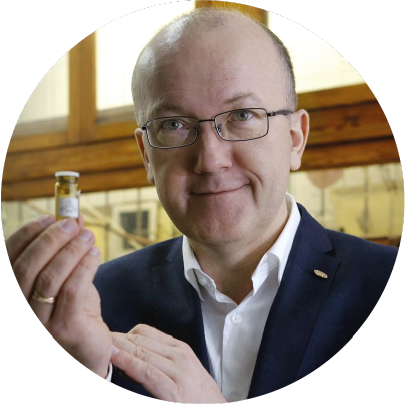
prof. Daniel Gryko, Institute of Organic Chemistry PAS – partner of APACE
The workshops are dedicated to members of the Institutes of Polish Academy of Sciences – project teams, both researchers and research managers at PAS Institutes, interested in applying for EIC Pathfinder 2025 grants.
Due to limited space, registration for the event is mandatory. Registration form available only for employees of the PAS Institutes.
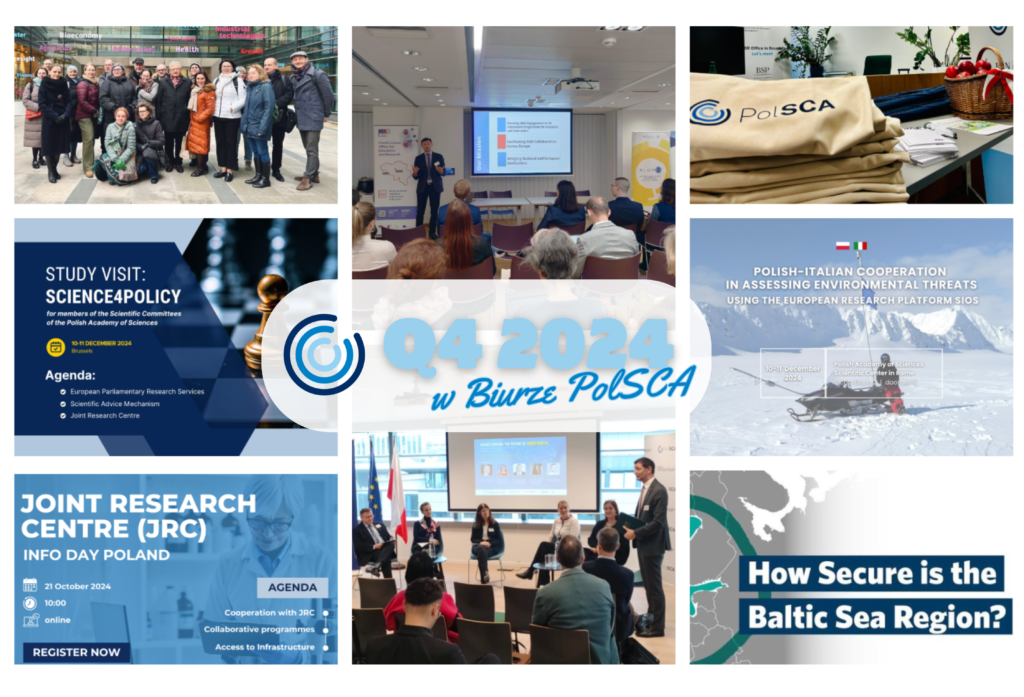
Quarterly Summary of PolSCA Office Activities – now available!
We are pleased to present the latest quarterly report on the activities of the PolSCA Office in Brussels. This document provides detailed information about our initiatives, events, and achievements over the past months of 2024.
What’s Inside the Report?
- Key events and meetings: A comprehensive overview of significant events and meetings organized by the PolSCA Office, including collaborations with European and international institutions.
- Research and Innovation endavours: summaries of research and innovation ventures we have been suuported.
- Strategic collaborations: insights into our strategic collaborations with national stakeholders and international partners.
- Trends and challenges: analysis of the latest trends and challenges in the fields of science, innovation and technology.
We invite you to read the full document to learn more about our efforts to support Polish scientists and promote international cooperation within the Horizon Europe Framework Program.

The IGLO Open Event on the R&I Priorities of Polish Presidency – Summary of the event
The IGLO Open Event focused on the R&I Priorities of the Polish Presidency, held on January 22, 2025, in Brussels, showcased Poland’s strategic vision for research and innovation during its presidency of the Council of the EU. Featuring keynotes on AI in science, Horizon Europe evaluation, and the European Research Area, along with insights from Polish ERC laureates, the event emphasized collaboration, inclusivity, and bold approaches to Europe’s scientific challenges.
The event was organised under the patronage of the Minister for European Union Affairs during the Polish Presidency of the Council of the European Union in 2025.
The IGLO Open Event on the R&I Priorities of Polish Presidency, organized by the PolSCA Office of the Polish Academy of Sciences in Brussels, in collaboration with the NCBR/BSP Offices in Brussels and the Permanent Representation of the Republic of Poland to the European Union, took place on January 22, 2025. The event served as a crucial forum to showcase and discuss Poland’s strategic vision and priorities in Research and Innovation (R&I) during its presidency of the Council of the European Union.
Almost a hundred participants representing European Commission, permanent representations of Member states in Brussels, liaison offices working in R&I, university alliances and other stakeholders took part in the event.
The seminar began with an insightful presentation by Magdalena Kula, the Research Attaché at the Permanent Representation of the Republic of Poland to the European Union. She emphasized that Europe’s two million researchers should be viewed as a significant advantage over competitors. She noted that R&I would be a common thread throughout various topics, with the presidency aiming to ensure that researchers are visible and heard in policy creation. Kula provided a comprehensive overview of the Polish Presidency’s agenda and its R&I priorities, namely: openness & inclusiveness, synergies and AI in science.
Regarding the rapidly evolving AI sector, the Polish research attaché mentioned:
“There is an opportunity for Europe to empower and upskill our researchers to use AI tools and technologies, in order to increase the productivity of research and innovation efforts.”
Poland plans to propose Council Conclusions on AI in science to this effect in the coming months, stressing that access to AI tools for research should be as democratic as possible not to exacerbate disparities within the scientific community.
Kula also addressed the ongoing work on interim evaluation of Horizon Europe that will serve as the evidence for discussing FP10, stating: “If you want to build a proper discussion on the future of the Framework Programme, we need those numbers [to be presented in the interim report]. We need to know what Horizon Europe has delivered, what worked, what didn’t work, and to build our discussion on the facts and data.”
Another significant objective for the first half of the year will be the European Research Area policy agenda for 2025-27, to be adopted as a Council recommendation. Poland will also work on extending the Euratom programme for nuclear research and innovation beyond 2027.
Following the first panel, three Polish ERC laureates presented their research in different disciplines anchored to Polish Presidency priorities:
- Dr. Ewa Chrostek (Jagiellonian University) – health research;
- Dr. Krzysztof Fic (Poznań University of Technology) – energy storage;
- Dr. Rafał Kucharski (Jagiellonian University) – AI in urban mobility.
The presentations served as a starting point for the a lively panel discussion, moderated by Professor Leszek Kaczmarek, a member of the ERC Scientific Council and a prominent figure at the Nencki Institute of Experimental Biology, PAS.
The panelists commented on how they tackle the leitmotiv of the Polish Presidency being it safety and /or security in their research. They also talked on where they find opportunities and threats in their respective fields. Dr. Kucharski discussed the transformative potential of AI in research, illustrating how AI technologies can accelerate scientific discovery and address complex societal issues. Dr. Fic emphasized the urgent need for innovative solutions in energy transition, highlighting the role of interdisciplinary research in developing sustainable energy systems and also the need for Europe to bypass the problem of scarcity of critical raw materials. Dr. Chrostek focused on health security, discussing recent advancements in biomedical research and the importance of international collaboration in prevention and containment of global health threats such as virus-borne diseases. During the Q&A session, she also stressed that “researchers are societal species, so it is essential to work together across Europe but also transversely through the different fields of science.”
When asked about important takeaways for the scientific community from a perspective of ERC grantees they all emphasised the need for cultural change that will accept more risk taking and room for failure as doing frontier science and making great leaps requires true creativity and decisions, all the other incremental science can be done by AI.
The event concluded with a light lunch, providing attendees with an opportunity to network and further discuss the topics covered. The IGLO Open Event successfully highlighted Poland’s strategic R&I priorities and fostered a collaborative environment for addressing Europe’s scientific challenges. The discussions and insights shared during the event underscored the importance of continued investment in research and innovation to drive progress and ensure a sustainable future for Europe.
Materials:
- Recap from the Event – PL / EN
- Magdalena Kula – Polish Presidency at the Council of EU.
- dr Rałał Kucharski – COeXISTENCE – What happens in the future when intelligent machines and humans share limited resources of urban mobility?
- dr Krzysztof Fic – (For Europe) Impossible is nothing.
- dr Ewa Chrostek – Mechano-Wolbachia – Uncovering the mechanisms of action of an antiviral bacterium.
- Agenda

Green Horizons Matchmaking: Building Partnerships for Sustainable Food Systems

Join us for the Cluster 6 Matchmaking Event, organized by the PolSCA Office of the Polish Academy of Sciences in collaboration with RTD liaison offices from Austria, France, Latvia, Spain, and Slovakia. This in-person event on 18th March 2025 in Brussels is your opportunity to connect with potential partners, share expertise, and build consortia for Horizon Europe’s 2025 Work Programme focused on biodiversity, sustainable farming, food systems, and climate resilience.
PolSCA Office of the Polish Academy of Sciences in Brussels in collaboration with 5 other RTD liaison offices in Brussels representing together 6 members states i.e. Austria, France, Latvia, Spain, Slovakia and Poland are organizing a matchmaking event for those interested in the upcoming calls for projects to be published within the Horizon Europe Work Programme 2025 under its Cluster 6. This event is dedicated to fostering collaboration within topics focusing on biodiversity, sustainable farming, food systems, plant and animal health, and climate resilience.
The event will be held in-person on 18th March 2025 in Brussels, Belgium.
The person attending the brokerage event should be able to engage in merit-based discussions on the presented project ideas or expertise that can be contributed to the consortium.
As the number of available spots is limited to 10 per country, we will select the participants based on the expression of interest provided in the e-mail to the organizers.
Why Attend?
- Meet potential partners from Austria, France, Latvia, Spain, Slovakia and more to form consortia.
- Gain insights into the Horizon Europe calls and increase your chances of success.
- Expand your network across sectors and disciplines.
Who Should Attend?
- Researchers and research institutes;
- SMEs and startups active in the agri-food, biodiversity, and sustainability sectors;
- Universities and other academic centres.
Event Details
- Time: 09:00 – 17:00 CET
- Location: [Venue details to be confirmed], Brussels, Belgium
For more details or to express your interest, please contact the PolSCA Office of the Polish Academy of Sciences (PAS) in Brussels at: izabela.maciejowska@polsca.pan.pl before 31st January 2025.
We look forward to seeing you at this event and working together toward a more sustainable, innovative, and resilient future for Europe.
Brainstorming the Future of Brain Health – recap from the event and materials now available!
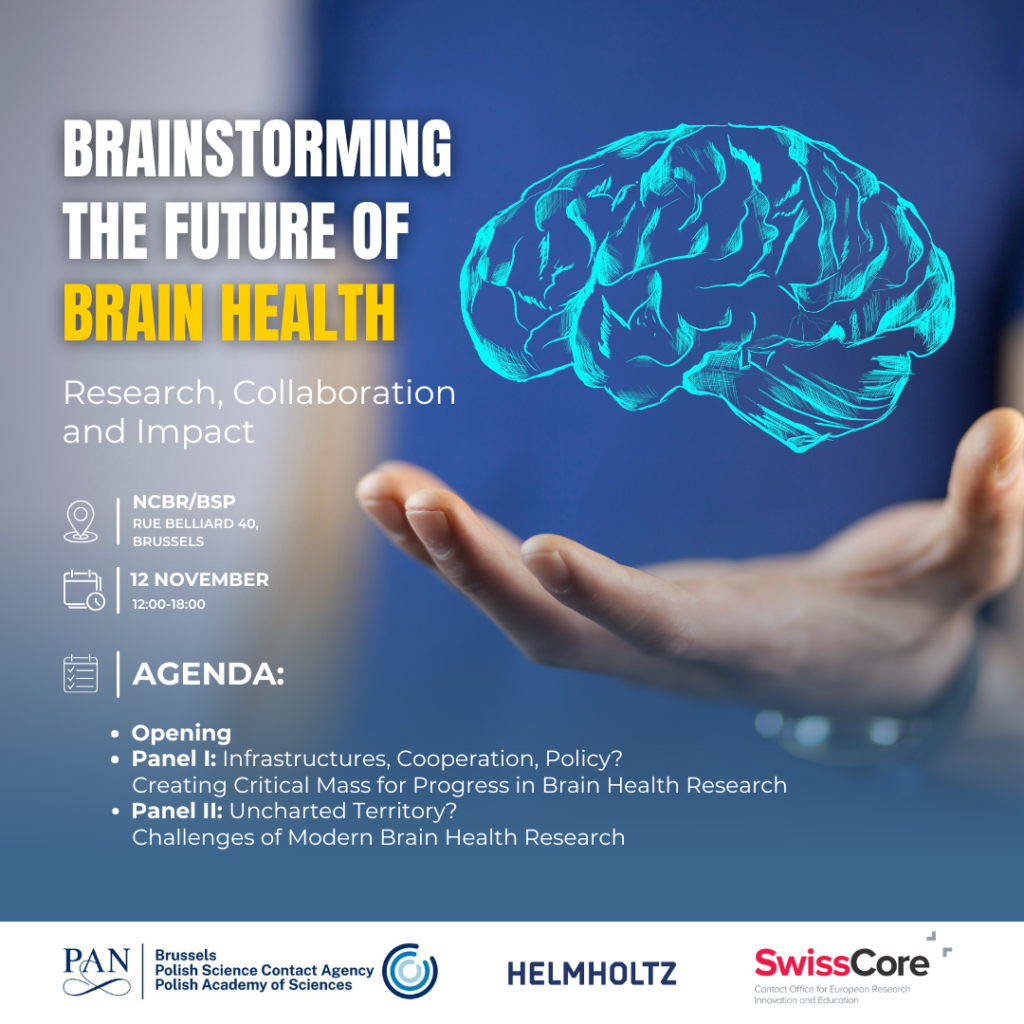
On 12th November 2024, the NCBR/BSP in Brussels hosted a pivotal event titled „Brainstorming the Future of BRAIN HEALTH: Research, Collaboration, Impact”. This event gathered almost 60 internationally renowned experts and guestes to explore new frontiers in brain health research, focusing on the expected impacts of the upcoming European Partnership for Brain Health.
16th Edition of V4 Training for Research Project Managers – Brussels, 4–6 November 2024
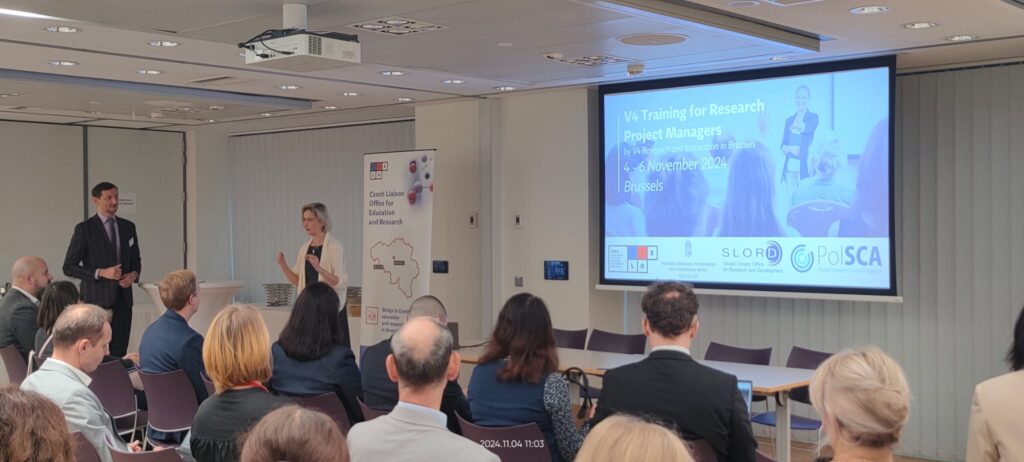
The 16th V4 Training for Research Project Managers took place in Brussels between 4-6th November. The event was targeted at experienced research project managers involved in international research projects, including Horizon 2020 and Horizon Europe.
This was the 16th edition of the training. So far there has been 487 participants, including 102 from Poland!
(wiecej…)Next Page »« Previous Page


