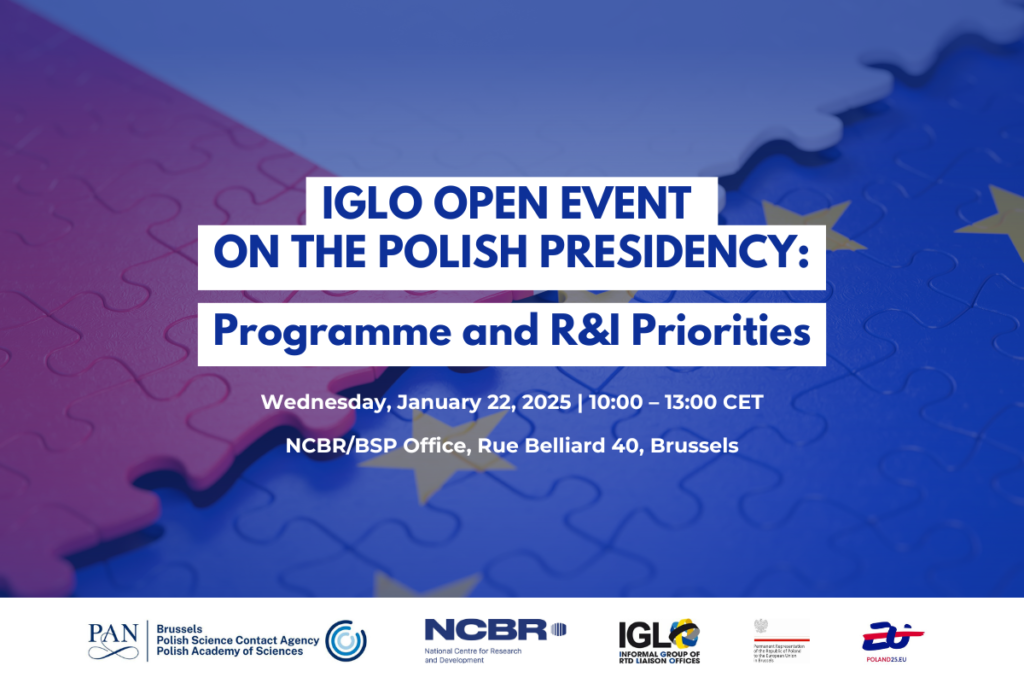
The IGLO Open Event focused on the R&I Priorities of the Polish Presidency, held on January 22, 2025, in Brussels, showcased Poland’s strategic vision for research and innovation during its presidency of the Council of the EU. Featuring keynotes on AI in science, Horizon Europe evaluation, and the European Research Area, along with insights from Polish ERC laureates, the event emphasized collaboration, inclusivity, and bold approaches to Europe’s scientific challenges.
The event was organised under the patronage of the Minister for European Union Affairs during the Polish Presidency of the Council of the European Union in 2025.
The IGLO Open Event on the R&I Priorities of Polish Presidency, organized by the PolSCA Office of the Polish Academy of Sciences in Brussels, in collaboration with the NCBR/BSP Offices in Brussels and the Permanent Representation of the Republic of Poland to the European Union, took place on January 22, 2025. The event served as a crucial forum to showcase and discuss Poland’s strategic vision and priorities in Research and Innovation (R&I) during its presidency of the Council of the European Union.
Almost a hundred participants representing European Commission, permanent representations of Member states in Brussels, liaison offices working in R&I, university alliances and other stakeholders took part in the event.
The seminar began with an insightful presentation by Magdalena Kula, the Research Attaché at the Permanent Representation of the Republic of Poland to the European Union. She emphasized that Europe’s two million researchers should be viewed as a significant advantage over competitors. She noted that R&I would be a common thread throughout various topics, with the presidency aiming to ensure that researchers are visible and heard in policy creation. Kula provided a comprehensive overview of the Polish Presidency’s agenda and its R&I priorities, namely: openness & inclusiveness, synergies and AI in science.
Regarding the rapidly evolving AI sector, the Polish research attaché mentioned:
“There is an opportunity for Europe to empower and upskill our researchers to use AI tools and technologies, in order to increase the productivity of research and innovation efforts.”
Poland plans to propose Council Conclusions on AI in science to this effect in the coming months, stressing that access to AI tools for research should be as democratic as possible not to exacerbate disparities within the scientific community.
Kula also addressed the ongoing work on interim evaluation of Horizon Europe that will serve as the evidence for discussing FP10, stating: “If you want to build a proper discussion on the future of the Framework Programme, we need those numbers [to be presented in the interim report]. We need to know what Horizon Europe has delivered, what worked, what didn’t work, and to build our discussion on the facts and data.”
Another significant objective for the first half of the year will be the European Research Area policy agenda for 2025-27, to be adopted as a Council recommendation. Poland will also work on extending the Euratom programme for nuclear research and innovation beyond 2027.
Following the first panel, three Polish ERC laureates presented their research in different disciplines anchored to Polish Presidency priorities:
- Dr. Ewa Chrostek (Jagiellonian University) – health research;
- Dr. Krzysztof Fic (Poznań University of Technology) – energy storage;
- Dr. Rafał Kucharski (Jagiellonian University) – AI in urban mobility.
The presentations served as a starting point for the a lively panel discussion, moderated by Professor Leszek Kaczmarek, a member of the ERC Scientific Council and a prominent figure at the Nencki Institute of Experimental Biology, PAS.
The panelists commented on how they tackle the leitmotiv of the Polish Presidency being it safety and /or security in their research. They also talked on where they find opportunities and threats in their respective fields. Dr. Kucharski discussed the transformative potential of AI in research, illustrating how AI technologies can accelerate scientific discovery and address complex societal issues. Dr. Fic emphasized the urgent need for innovative solutions in energy transition, highlighting the role of interdisciplinary research in developing sustainable energy systems and also the need for Europe to bypass the problem of scarcity of critical raw materials. Dr. Chrostek focused on health security, discussing recent advancements in biomedical research and the importance of international collaboration in prevention and containment of global health threats such as virus-borne diseases. During the Q&A session, she also stressed that “researchers are societal species, so it is essential to work together across Europe but also transversely through the different fields of science.”
When asked about important takeaways for the scientific community from a perspective of ERC grantees they all emphasised the need for cultural change that will accept more risk taking and room for failure as doing frontier science and making great leaps requires true creativity and decisions, all the other incremental science can be done by AI.
The event concluded with a light lunch, providing attendees with an opportunity to network and further discuss the topics covered. The IGLO Open Event successfully highlighted Poland’s strategic R&I priorities and fostered a collaborative environment for addressing Europe’s scientific challenges. The discussions and insights shared during the event underscored the importance of continued investment in research and innovation to drive progress and ensure a sustainable future for Europe.
Materials:
- Recap from the Event – PL / EN
- Magdalena Kula – Polish Presidency at the Council of EU.
- dr Rałał Kucharski – COeXISTENCE – What happens in the future when intelligent machines and humans share limited resources of urban mobility?
- dr Krzysztof Fic – (For Europe) Impossible is nothing.
- dr Ewa Chrostek – Mechano-Wolbachia – Uncovering the mechanisms of action of an antiviral bacterium.
- Agenda



