EMERGE-EU Study Visit Recap: Building European Connections in Advanced Materials
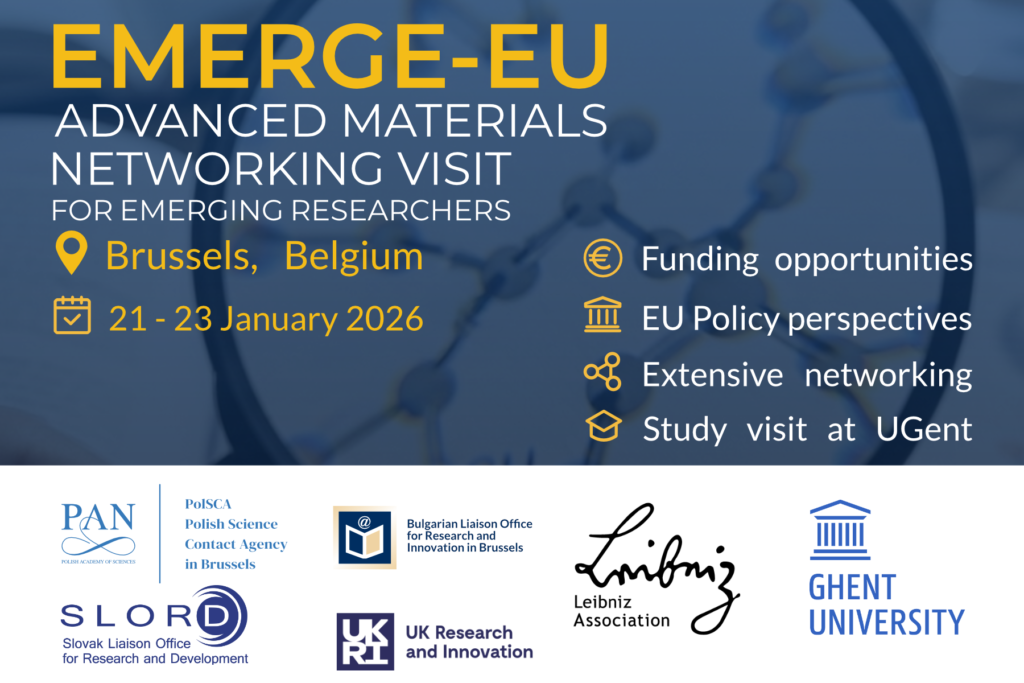
For the first time, the PolSCA PAS Office engaged in the organisation of an international study visit addressed directly to researchers, rather than to its traditional national audiences or expert and managerial communities. Within the framework of the EMERGE-EU initiative, PolSCA co-organised a three-day networking study visit for emerging researchers in advanced materials, implemented in cooperation with fellow Brussels-based liaison offices. This marked a new experience for the Office – both in terms of the target group and the international format – complementing PolSCA’s previous activities focused on funding instruments such as ERC and MSCA, or science-for-policy initiatives addressed primarily to the scientific committees of the Polish Academy of Sciences. Further details on the programme and outcomes of this study visit are presented below in the full recap.
(wiecej…)EMERGE-EU – PolSCA Office study visit to Brussels focusing on advanced materials
January 21 – January 23
PolSCA Office of the Polish Academy of Sciences is organising a study visit to Brussels focusing on Advanced Materials. This pilot project is an extension of the PolSCA Office’s activities for scientists, building on the success of a similar format implemented for research managers.
The study visit is being carried out in cooperation with international partners from Belgium, Bulgaria, Germany, Slovakia and the United Kingdom. This ensures an international composition of the group, promoting networking and cooperation in the field of new and advanced materials.
The EMERGE-EU study visit will take place on 21–23 January 2026 in Brussels. The participants of the visit are researchers working in the field of Advanced Materials who are at an early stage of their academic careers, i.e. postdoctoral researchers transitioning from R2 to R3. The study visit is an excellent opportunity for future scientific leaders interested in further strengthening their research careers and engaging in international cooperation.
The programme includes the following:
- sessions devoted to the perspective of the Directorate-General for Research & Innovation on advanced materials,
- sessions focused on opportunities offered by the European Research Council (ERC), the COST programme, and EIC instruments,
- sessions addressing issues related to research careers in the context of the European Research Area (ERA),
- matchmaking in a small, international group, including short participant presentations and one-to-one meetings,
- a study visit (site visit) to Ghent University.
This EMERGE-EU study visit is one of the activities organised by the PolSCA PAN Office to strengthen the presence of Polish scientists in the European research and innovation ecosystem, particularly in the field of new and advanced materials. The aim is to support researchers in developing their skills at the transition stage to scientific independence, help them to find their way around the European institutional environment, and build lasting international cooperation networks that can form the basis for future research projects and initiatives at a European level.
Detailed programme of the EMERGE-EU study visit is available here
Public consultations on the Advanced Materials Act (AMA)
The European Commission conducted public consultations on the Advanced Materials Act (AMA) until 13 January 2026. The initiative aims to strengthen the EU’s technological competitiveness and accelerate the deployment of innovations in the field of advanced materials. The AMA is intended to create a coherent and innovation-friendly regulatory framework and to support technology scale-up as well as the transfer of research results to industry. More information about this process is available on the PolSCA Office website.
Summary of the EMERGE-EU study visit is available here
How to prepare an effective EoI that will open the door to Horizon Europe consortia
Expression of Interest (EoI) is a concise, strategic tool for research institutions and researchers. It helps individuals present their profile to prospective project coordinators and supports efforts to increase the visibility of Polish institutions in European science.
The EoI is the next stage of integration into the cooperation network, following our 2024 work organising institutional information and publishing folders for PAN institutes. The second edition of these brochures will appear with WP26-27. EoI documents shift this work from a static presentation to partner-seeking and participation in international consortia.
A well-prepared Expression of Interest (EoI) document is a gateway to international projects, new partnerships and influence on European research agendas. This article shows how to build a strong and convincing EoI in a few clear sections.
Why EoI matters
EoI is a short strategic document designed to present and promote scientific activities to potential coordinators and partners of international projects.
A well-structured EoI:
• increases the visibility of the institution on the European research and innovation map,
• highlights the competence and experience of the team,
• precisely matches the research profile to specific topics and calls for proposals under Horizon Europe.
Structure of an effective EoI

1. Title
The title should be concise, precise, and clearly indicate the institution’s role and its connection to the call in question.
When preparing the title:
• include the programme (e.g. Horizon Europe), the year and the intended role (coordinator/partner),
• refer to the cluster or topic,
• Avoid general terms such as ‘Partner Search’.
Example:
„ Expression of Interest for Horizon Europe 2025: Partner Role in Cluster 6 Call”.
2. Profile of the institution/research team
Describe the entity in a few sentences: name, department/institute, city and country, website and mission. Focus on strengths and alignment with EU priorities (e.g. Green Deal, Digital Transformation, EU Missions).
Example:
Center for Circular Innovations (CCI), Environmental Systems and Policy, Sweden. We lead research on circular resource use, policy innovation, and urban sustainability. Our mission is to provide evidence-based solutions that accelerate the EU’s transition to a climate-neutral economy.
3. Matching the competition – Call i Topic
This element links the EoI to a specific call on the Funding & Tenders portal. Enter the exact name of the cluster, the call code, the official title of the topic and the deadline for submitting the application. Accuracy builds trust and facilitates partner selection.
Example:
Cluster: 5 – Climate, Energy and Mobility
Call code: HORIZON-CL5-2026-02
Topic: New CO2 capture technologies
Deadline: 17 February 2026
4. Research areas and interests
Clearly indicate your research areas and thematic topics using keywords from the call text. Show the social relevance and link to EU policies. Short lists from ‘Research domains’, ‘Relevant themes’ and ‘Keywords (from the call)’ work well.
Example:
Research domains: environmental humanities, participatory democracy, social resilience
Relevant themes: climate adaptation, citizen engagement, media literacy, cultural transformation
Keywords (from the call): resilience, co-creation, behavioural change, foresight, inclusion
Contribution to EU Priorities:
Supports EU Climate Adaptation Mission through cultural engagement
Strengthens democratic values as per the EU Rule of Law Mechanism
5. Competences and resources
Partners are not only looking for ideas. Present your scientific competencies, the infrastructure at your disposal, the interdisciplinary networks in which you operate, and your geographical reach.
Example:
| Area | Description |
| Scientific Expertise | Longstanding SSH experience in migration, governance, and policy evaluation. |
| Infrastructure | Digital archives; participatory design labs; AI-driven ethnographic tools. |
| Interdisciplinary Links | Collaboration with legal scholars, engineers, and health researchers |
| Geographic Reach | Strong networks in CEE, Balkans, and Eastern Partnership countries. |
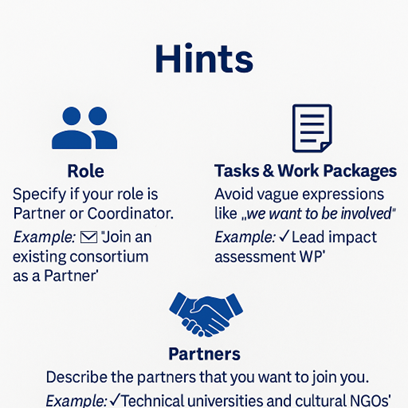
6. Role in the project and preferred collaboration
Define what role you want to take on in the project, whether you want to coordinate the project or join as a project partner, and what work packages (WPs) you can lead or support.
Examples:
„lead impact assessment WP”, „co-creation methodology”, „policy recommendations”, „case study z Europy Środkowej”.
7. Project concept (if you are coordinating)
In a few sentences, present the working title, an outline of the innovation, the technological and societal readiness level (SRL/TRL), links to relevant policies, and expected results. Refer to the ‘expected outcomes’ and ‘scope’ sections in the topic documentation.
Example:
Working Title: “CIVIC-MAP – Mapping Civic Resilience in Polarised Societies” Summary (2–3 lines): A cross-national study of citizen trust and policy innovation, linking cultural heritage and participatory governance Innovation Aspect: Combines foresight modelling and digital storytelling to enhance civic dialogue TRL / SRL: Social Readiness Level (SRL) 4–6 – Validated approach tested in pilot contexts Policy Link: Aligns with European Democracy Action Plan and Pact for Skills
8. Substantive contribution (if you are a partner)śli jesteś partnerem)
If you are joining the consortium, focus on your contribution and how it will help achieve the results expected by the European Commission.
Examples:
• Expertise in data-driven cultural policy analysis (aligned with WP’s expected impact on evidence-based governance)
• Access to a comparative database of education-to-labour transitions (supports “social inclusion” objectives)
• Methods in participatory mapping and gamified learning (aligned with calls for inclusive and creative digital tools)
• Piloting experience with secondary schools in CEE (adds regional and demographic diversity)
9. Project experience in the EU
List the most relevant projects (H2020/HEU/Interreg/COST/Erasmus+), roles (coordinator/WP leader/partner) and relevance to the topic. Limit yourself to examples that really strengthen your credibility in this particular call.
Example:
Our institute has participated in five Horizon-funded projects related to sustainable land use and climate adaptation, leading WP tasks on socio-economic modelling and data integration
10. Achievements and references
List awards, publications in recognised journals, participation in the creation of policy reports, membership in European partnerships and networks. Keep the information up to date and relevant – limit yourself to short, specific details, preferably in a list.
Examples:
Contributed to the 2023 EU Bioeconomy Strategy Report;
Member of the European Circular Cities Network;
Published in Journal of Cleaner Production and Resources, Conservation & Recycling
Good practices for preparing an EoI
Use vocabulary from the competition documentation – this will increase recognition and relevance.
• Incorporate references to EU policies (e.g. Green Deal, EU Missions).
• Ensure consistent branding and formatting: a fixed template makes for easy reading.
• Avoid generalities such as ‘we want to participate’; instead, specify the tasks and WP in which you want to actively participate.
• In the PDF/web version, include links to your research group’s website and the call in Funding & Tenders that you are interested in.
An EoI is not just a document, but above all a tool for building a position in European research ecosystems. It is a logical continuation of our presentation activities (including the PAN institutes folder) and, at the same time, the first step towards actively acquiring partners and increasing participation in international projects.
Each well-prepared EoI is another brick in the strategic strengthening of the presence of Polish entities in Horizon Europe. Each well-prepared EoI is a brick in strengthening the presence of Polish entities in Horizon Europe. The EoI is a strategic document that opens the door to international cooperation. Its strength lies in its specificity, consistency, and relevance to the competition topic.
Diamond ERA: From Vision to Implementation – A New Definition of Openness in the European Research Area
On December 3–4, 2025, an in-depth debate on the future of science communication in Europe took place in Brussels. The conference “Diamond ERA: Fostering Openness in the European Research Area”, organized by the Digital Humanities Centre at the Institute of Literary Research of the Polish Academy of Sciences (IBL PAN) and the Polish Science Contact Agency (PolSCA PAN), in cooperation with the Committee on Literary Studies of the Polish Academy of Sciences and the OPERAS research infrastructure, gathered a wide group of stakeholders at the Permanent Representation of the Republic of Poland to the EU: from European Commission decision-makers, through grant providers, to librarians and infrastructure creators.
(wiecej…)V4 Training for Research Project Managers – we are now accepting applications for the next edition (spring 2026)!
V4 Training for Research Project Managers – we are now accepting applications for the next edition (spring 2026)!
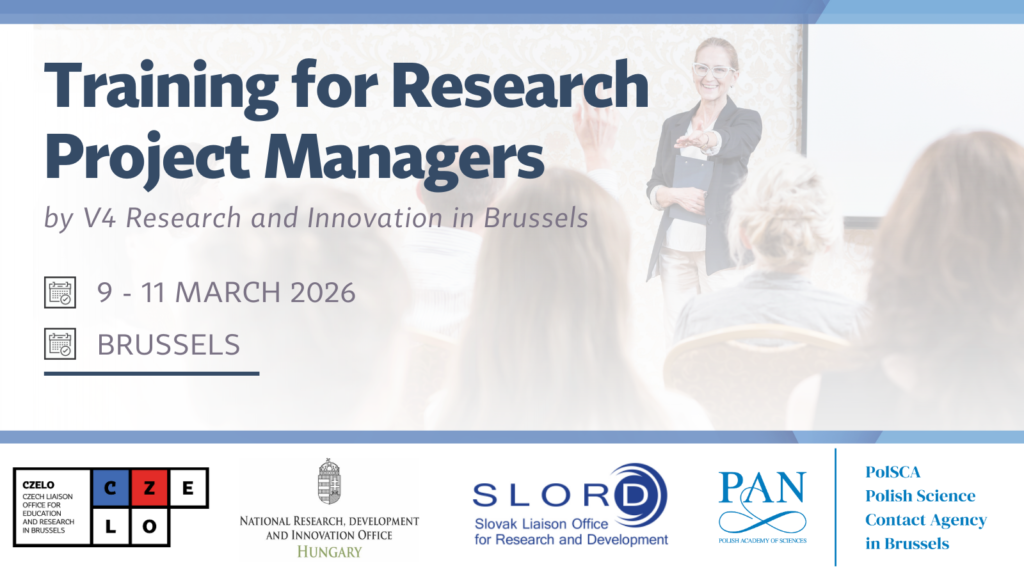
We invite you to participate in the next edition of our flagship training course, ‘V4 Training for Research Project Managers’, which will take place in Brussels on 9, 10 and 11 March 2026. As in previous years, we are co-organising it in cooperation with the Czech Liaison Office for Education and Science (CZELO), the National Research, Development and Innovation Office in Hungary (NRDIO) and the Slovak Liaison Office for Research and Development (SLORD).
(wiecej…)Diamond ERA: Fostering Openness in the European Research Area – open event!
December 4, 2025 All day
Join leading Polish & European research institutions for a live, in-person conference in Brussels on Diamond Open Access, shaping the future of fair and innovative publishing in the Social Sciences and Humanities. Registration is required.
(wiecej…)Join the consultation on the Advanced Materials Act – help shape the future of innovation in Europe

Europe wants to strengthen its leading position in advanced materials as the foundation for many breakthrough technologies: from electronics and batteries to sustainable construction, and from aviation and defence. To create effective, innovative-friendly regulations, the European Commission has launched a public consultation on the Advanced Materials Act (AMA). Details below and in the Commission’s direct announcement (link HERE).
Why is AMA being created?
The AMA is set to become one of the key elements of the Competitiveness Compass package, which aims to accelerate the path ‘from lab to factory’, remove regulatory barriers and strengthen European technological competitiveness.
The future legislation on advanced and innovative materials builds on previous EU actions in this area, in particular the European Commission’s February 2024 Communication „Advanced Materials for Industrial Leadership” This policy marks the beginning of the process of creating a dynamic, secure and inclusive ecosystem for advanced materials in Europe, which will ensure Europe’s research leadership and accelerate the market implementation of innovations by mobilising coordinated EU, national, regional and private investment for this purpose.
Why is it worth speaking up?
Consultations are a space where the needs of large enterprises can be heard, as well as the perspectives of start-ups, scientists and public administration.
It is an opportunity to:
• identify barriers that hinder the scaling of innovation,
• emphasise the need to develop research infrastructure,
• propose solutions to improve access to financing,
• support the creation of clear and predictable regulations,
• showcase Poland’s potential in the field of advanced materials.
The more consistent, factual and real-life experiences from Poland, the greater the impact on future EU priorities.
What do the consultations cover?
The consultations cover:
• directions for research and innovation in the field of advanced materials,
• building European production capacity and increasing strategic independence,
• needs related to research infrastructure, technology transfer and scaling up innovation,
• security, eco-design and sustainability issues,
• market and regulatory barriers hindering the implementation of new materials,
• streamlining regulatory procedures and shortening the time-to-market.
Who can participate?
Anyone can participate in the consultation, including research institutions, companies, industry organisations, administrative bodies, and individuals.
How to participate?
The consultation is conducted via the „Have Your Say”, portal in two forms:
- Call for Evidence – open contributions published on the consultation website
- Public Consultation – online questionnaire with data aggregated by the EC
Responses can be submitted until 13 January 2026.
Below you will find links to material prepared by the EC’s Directorate-General for Research and Innovation to prepare users for the consultation process: in English and in Polish.
Good practices, competences and infrastructure of Polish science can have a real impact on the shape of the future Advanced Materials Act. It is worth taking advantage of this opportunity to highlight the Polish perspective in the European debate and actively co-create the legal framework that will be in force for years to come.
Take part. Share your experience. Let’s work together to ensure that Europe, including Poland, is at the centre of global materials innovation.wacji materiałowych.
ADDITIONAL INFORMATION:
The PolSCA PAN office in Brussels, together with local partners representing a total of six European countries (BE, BG, DE, PL, SK and the EU), is currently preparing an Emerge-EU study visit dedicated entirely to Advanced Materials. The initiative is intended for researchers wishing to strengthen their independence (stages R2/R3) and is scheduled for 21-23 January 2026. Details will be available soon.
Horizon Europe Navigators Meetup – next framework porgramme FP10
Horizon Europe Navigators Meetup: the next framework programme – Horizon Europe 2028-2034
November 28, 2025 09:30 – 11:00
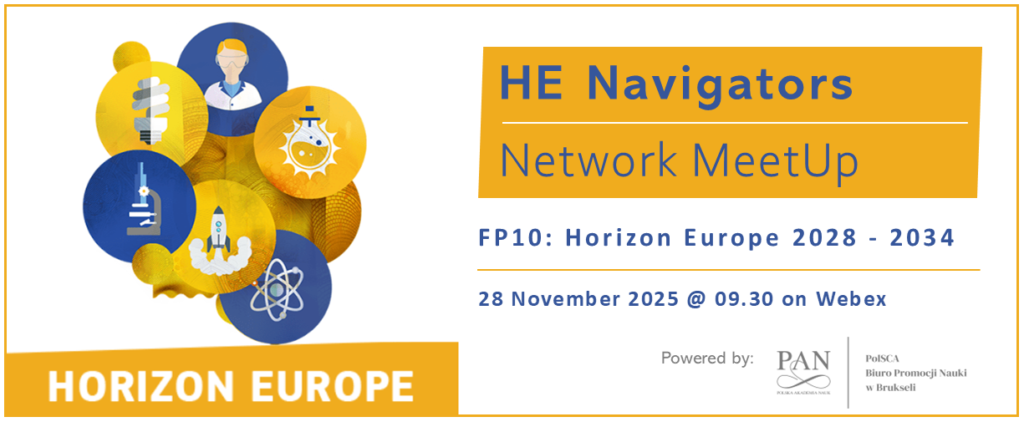
The 2025 brings a pivotal moment for the European research and innovation landscape – the publication of the European Commission’s proposal for the next Framework Programme for Research and Innovation (FP10), covering the years 2028–2034.
During the webinar, we will explore the main elements of the FP10 proposal, learn about its key novelties and continuity aspects, and discuss how the R&I community – including universities and research-performing organisations – perceives this new framework. Beyond usual members of the HE Navigators network, the meeting will be open to management of the Academy, incl. scientific leadership across 67 PAS institutes and PolSCA Advisory Council.
Matchmaking event – MEDIA, MIGRATION and EDUCATION – event summary!
Summary of the event!
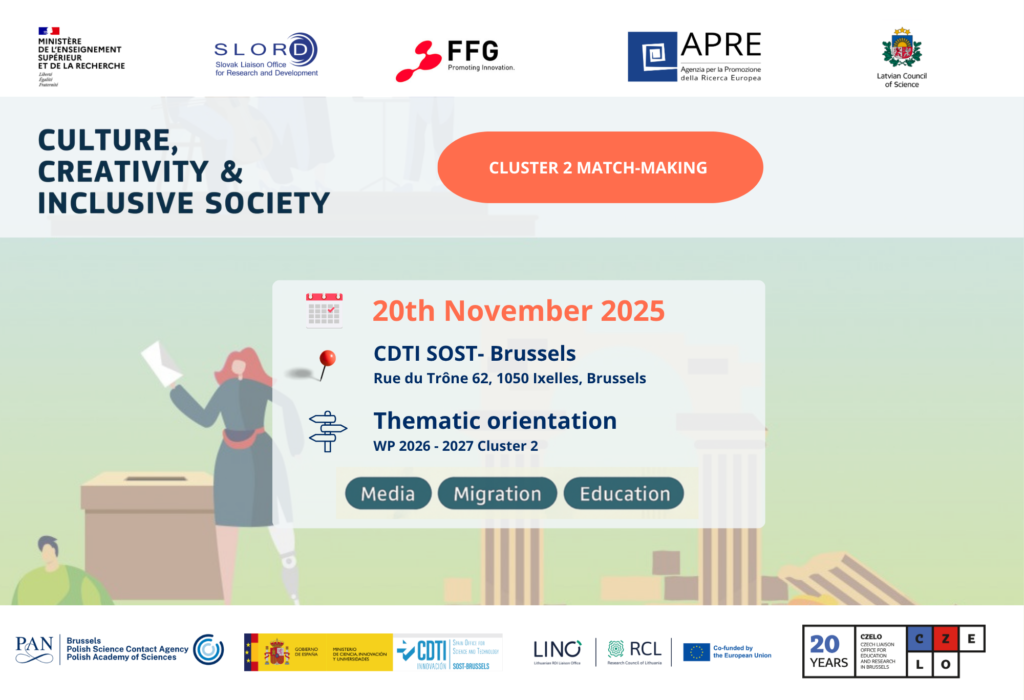
The “MEDIA, MIGRATIONS and EDUCATION” match-making event took place on 20 November 2025 in Brussels and was an international meeting dedicated to upcoming calls under Cluster 2 of the Horizon Europe programme, with a particular focus on media, migration and education topics. The event was organised by the PolSCA PAN Office in cooperation with liaison offices gathered in the IGLO network, representing a total of 10 EU Member States, including Austria, the Czech Republic, France, Italy, Latvia, Lithuania, Poland, Slovakia and Spain, with the participation of partners from the Netherlands. We had the pleasure of hosting almost 60 representatives of the European research and innovation community.
(wiecej…)MEDIA, MIGRATION and EDUCATION – Cluster 2 Matchmaking event
November 20, 2025 All day
The PolSCA office, in cooperation with the IGLO liaison offices in Brussels representing a total of 12 Member States: Austria, Czech Republic, France, Italy, Latvia, Lithuania, Poland, Slovakia and Spain, with the possible participation of representatives from Germany, the Netherlands and the United Kingdom, is organising a matchmaking event for those interested in the upcoming calls for proposals to be published under the 2026-2027 Work Programme – Cluster 2. The event will take place in person in Brussels on 20 November 2025 and will focus on topics related to media, migration and education.
(wiecej…)Next Page »« Previous Page


